
On 5 September the CNA, one of Italy’s craft and small business associations, published a report called Imprese senza ricambio, businesses with nobody to hand over to. It contains a number worth reading twice.
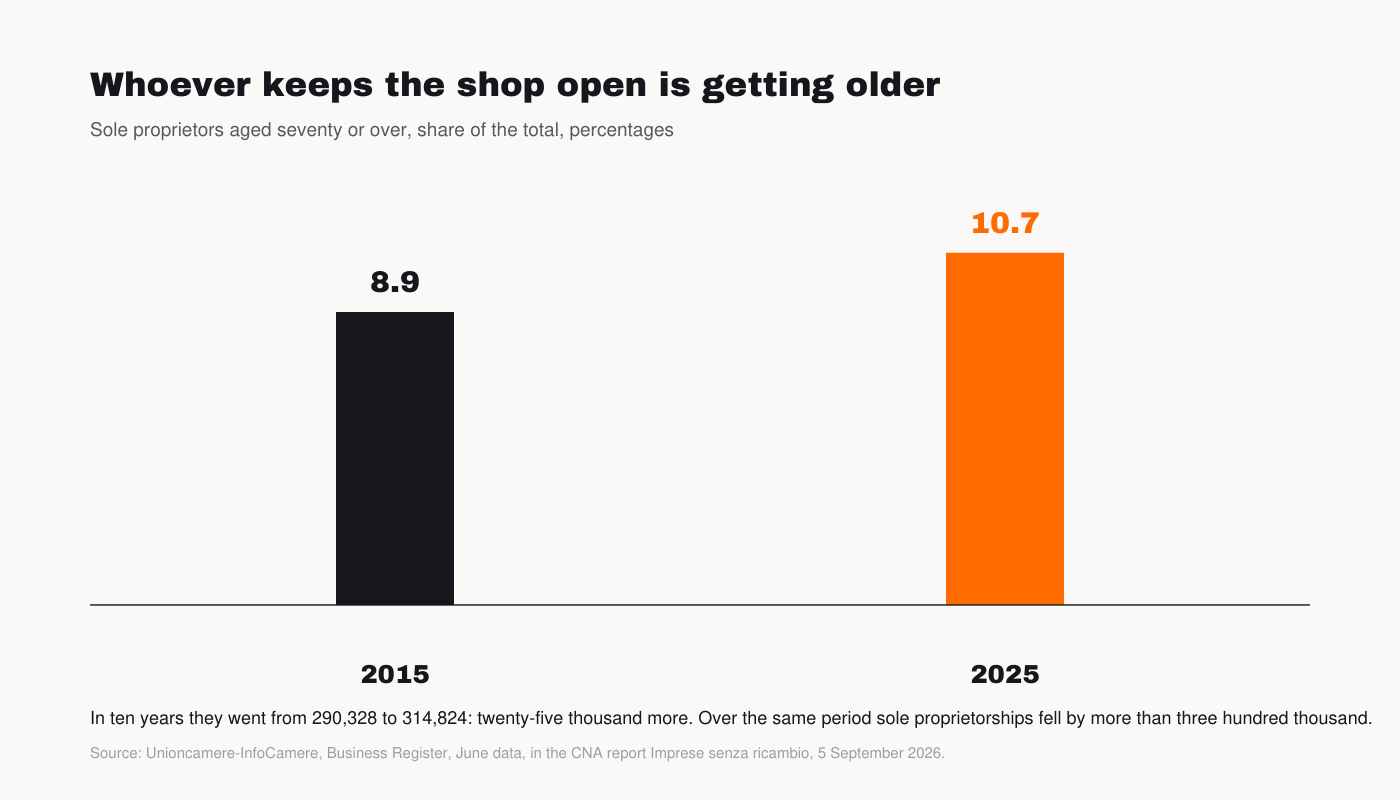
In June 2025 there were 314,824 sole proprietors aged seventy or over, 10.7 per cent of the total. Ten years earlier there were 290,328, or 8.9 per cent. Twenty-five thousand more, over a decade in which the total number of Italian sole proprietorships fell by more than three hundred thousand.
Source: Unioncamere and InfoCamere, Business Register data, press release of 8 August 2025, quoted in the CNA report of 5 September 2026.
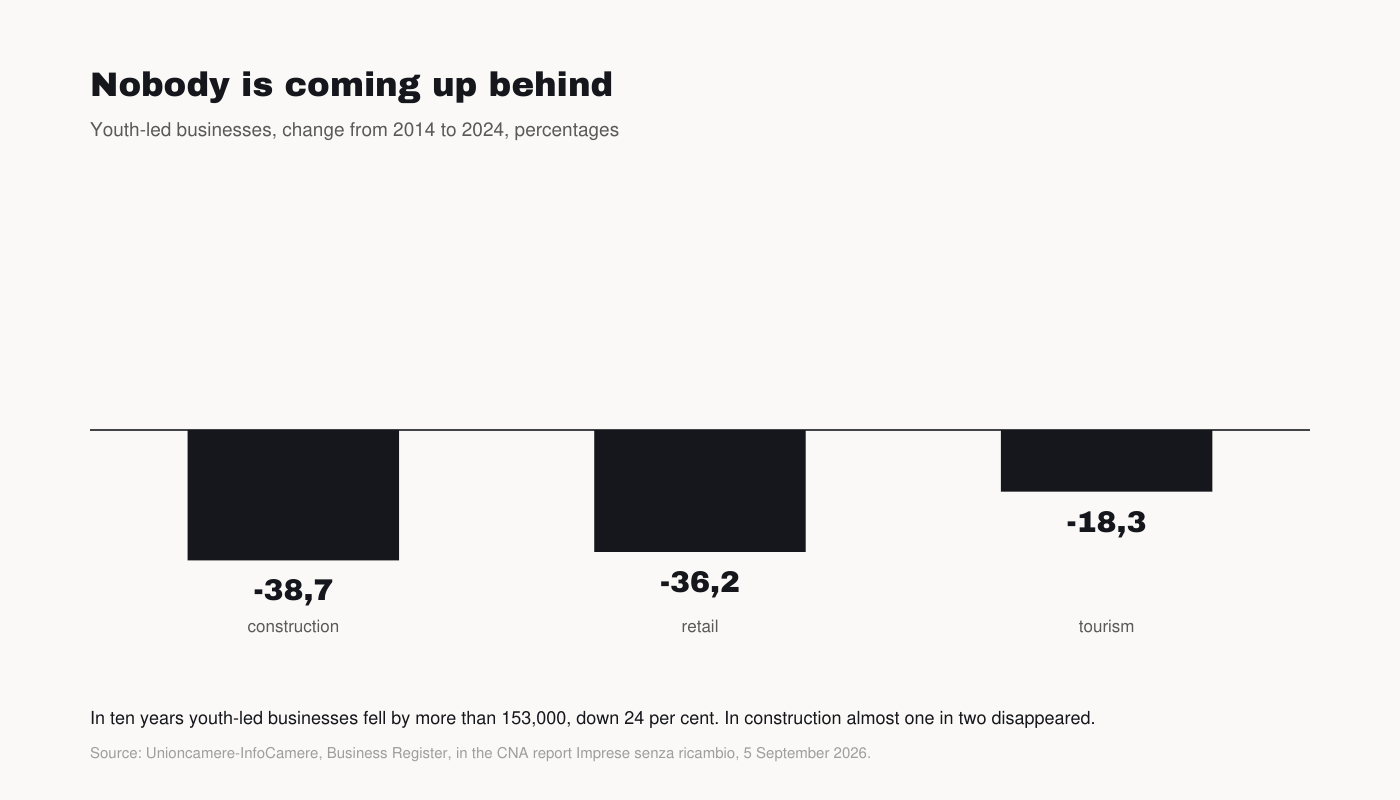
Taken separately, those two numbers say something else. Older owners are not increasing because Italy is ageing. They are increasing because they stay: the business passes to nobody, so whoever is there keeps it open. Meanwhile, between 2014 and 2024, businesses run by young people fell by more than 153,000, down 24 per cent. Construction lost 38.7 per cent, retail 36.2, tourism 18.3.
Where it bites
In farming almost one owner in three is past seventy, 28.3 per cent. In manufacturing crafts it is 9.6 per cent, in retail 7.8, in hospitality 6.6, which means more than twelve thousand six hundred people. By sheer numbers the first province is Naples, with over 11,600, then Rome with more than 10,200, then Milan.
The CGIA of Mestre counted the same thing from another angle in August: 434,000 fewer artisans in ten years, down 25.1 per cent.
Commenting on the report, the president of the CNA said that every closure is a loss of “skills, professionalism, relationships with customers and suppliers”.
He is right. And he has just described a different problem from the one he was talking about.
What disappears, and appears on no balance sheet
When a business closes, somebody buys the machines. The walls are sold or let. The stock is liquidated. All of it has a price, and the price gets written into a deed.
Then there is the rest, and the rest is the large part. Which supplier will deliver on Saturday if you ask on Thursday. Which customer pays at sixty days without saying so, and which pays at thirty if you call. Why in 2019 you turned down a contract that looked good, and what happened to the people who took it. How that machine behaves when it makes that noise. What time on Friday you place the order, and why that hour and not another.
None of this is written anywhere. It sits in one person’s head, and the day that person stops, it stops with them. It does not lose value and it does not get sold off: it vanishes, and the next day it is as if it had never existed.
Nobody knows what it is worth, because nobody has measured it. Look for a figure on how long it takes a new person to know what the one who left knew, and you find numbers bouncing from one article to the next without anyone naming the study behind them. Eight months to full productivity, replacement costs between fifty and two hundred per cent of annual salary: repeated everywhere, verifiable nowhere. We count the businesses that close down to the decimal. What leaves with them nobody counts, and nobody mourns.
The serious objection, best faced now
By this point anyone who works with their hands has stopped reading, and they have a good reason.
In 1966 Michael Polanyi wrote a sentence that has closed the argument ever since: we can know more than we can tell. His example is the cyclist, who can ride a bicycle and cannot explain how he keeps his balance. It holds for the baker whose hands know the dough is ready, for the mechanic who hears something in the engine, for the person who looks across a dining room and knows in three seconds how the evening is going.
That cannot be written down. Anyone who says it is enough to write it has never done that job, and Polanyi took the idea apart sixty years ago. In business the argument arrived with Ikujiro Nonaka: tacit knowledge passes by working alongside someone, one watches and the other does, which is why the workshop worked for six hundred years.
And not every business that closes closes because of a mistake. Sometimes the trade is no longer needed, and keeping it alive at someone else’s expense is not industrial policy, it is a subsidy with another name.
What can be written, and nobody writes
Polanyi was talking about the gesture. Decisions are another matter.
The reason you chose that supplier over the cheaper one is not tacit knowledge: it is a piece of reasoning, with something that happened to you inside it. You can say it. You never have, because nobody ever asked and because it seemed it would stay obvious forever.
Take something you have done the same way for twenty years and ask yourself whether you could explain out loud why you do it that way. If the answer is yes, that thing can be written and has not been. If the answer is no, then it is real craft, and for that you need a person beside you for a year.
Almost everything that is lost when a business closes belongs to the first group.
I know this from myself. I do dozens of things every day without thinking: I learned them by stealing the trade, watching whoever was doing them and trying until they came out right, and now they are part of me. If I had to explain one, I would have to watch my own hands to work out what they are doing.
There is an older name for this, and it is more precise than ours: wu wei, effortless action. Zhuangzi told it through Cook Ding, who carved an ox in front of the king: after nineteen years his blade was as sharp as on the first day, because he had stopped cutting and followed the joints. At the start, he says, I saw the whole ox. After three years I no longer saw it.
That part cannot be written, and rightly so. But the day I close, everything else goes too, and it has nothing to do with the ox: the decisions, the reasons, the people to call. And that was never tacit knowledge. It was just something I never wrote down.
What has changed, and how long change really takes
Until a few years ago writing all this was a second job. You had to sit down, choose a structure, keep it in order, find things again. Nobody who opens at six in the morning has ever done it, and they were right: we were asking them to be an archivist after their shift.
That excuse is gone. A machine does the boring part: decisions get dictated while driving, and something else puts them in order, ties them to people and dates, and finds them the day they are needed. Nothing to learn and no course to take: it is an archive that keeps itself. Anyone still saying they have no time is saying something else.
It has already happened to me, on something I would have sworn I remembered well. Last month I had an example in mind that seemed perfect: what we were promising to abolish here, Madrid had replaced rather than switched off. It sounded so good I was about to write it.
I had it checked first, and it did not hold. Madrid had tried to abolish, and hard: the moratorium on fines lasted five days, from 27 June 2019 until a judge suspended it. It was not political wisdom, it was a court.
Those dates I could not have repeated under torture. They now sit in a file, together with the reason the example should not be used, and the day it comes back to me, because it will come back to me, what answers will not be my memory.
Writing it down, though, is not enough. An archive nobody opens is paper. The European Central Bank measured in August that the use of artificial intelligence at work went from 26 to 52 per cent in two years, while the efficiency gain for the economy stays at 3.8 per cent, with productivity rising 0.35 points a year. Sam Altman, who sells the technology, said it in August against his own interest: the economy has an enormous amount of inertia, people carry on doing the same things, and everyone got the timing wrong.
Sources: European Central Bank, blog post of 26 August 2026 on the Consumer Expectations Survey, twenty thousand respondents a month across eleven countries; Sam Altman on David Senra’s Founders podcast, 23 August 2026.
Writing the archive has become almost free. Reading it and using it still takes a person, and that is where almost everything stops.
What I would ask for, if I could ask one thing
On succession the talk is almost always about tax and notaries. Those things matter, and meanwhile the big piece stays out of the conversation.
A business that closes because the market moved past it has run its course. A healthy business that closes because what held it together sat in one person’s head is a dead loss, and it appears in no statistic.
There is no law to change here, and nothing to ask anyone for. What has to go is the story we tell ourselves, that the trade passes on by being watched: watching takes two people, and the second one, more and more often, is not there.
Anyone can inherit the building. What you know is inherited only if somebody wrote it down. Whoever does not write it is not guarding a secret: they are deciding, without telling anyone, that it ends with them.
It costs half an hour a week. It is the lowest price you will ever be asked for something that is worth all the rest.