
Three hundred and thirteen hours
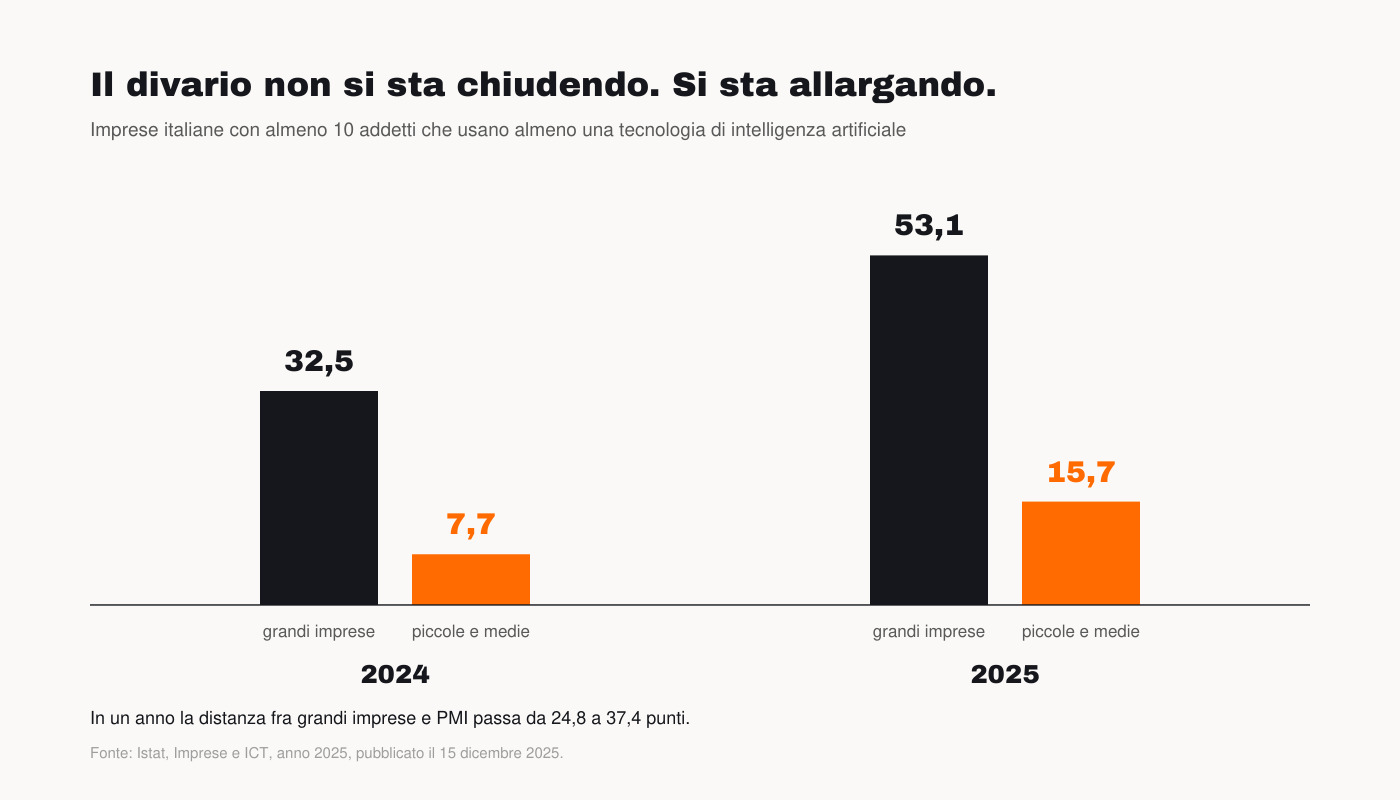
On 15 December 2025 Italy’s national statistics institute published its figures on the use of artificial intelligence by Italian firms. Among large companies, 53.1 per cent now use it, up from 32.5 a year earlier. Among small and medium ones, 15.7 per cent, also roughly double the 7.7 of the year before.
Both doubled, so it sounds like good news all round. It is not. When you double from thirty-two and I double from eight, the distance between us does not shrink, it grows. It was twenty-four and a half points, it is now thirty-seven and a half. Istat states it plainly: the gap between large firms and SMEs went from around twenty points in 2023 to thirty-seven in 2025.
And this is not an Italian oddity. The European figures for the same year say the same thing with different numbers: 55 per cent of large European enterprises use AI, against 30.4 per cent of medium and 17 per cent of small ones. Same gap, same continent.
The sums do not add up
There is something here worth looking at closely, because it cuts against what we have been telling ourselves for three years.
Artificial intelligence has never been this cheap. It no longer needs an IT department, it no longer needs a six-month project, and for many tasks it does not even need code: you explain in plain language what you want. If the barrier were price or difficulty, the gap should be closing on its own, because this technology has reached the bottom of the market faster than any before it.
Instead it widens. Which means the barrier is something else, and we have spent three years arguing about the wrong one.
Three hundred and thirteen hours
The barrier is time, and there is a number for it.
CNA, one of Italy’s associations of small business, calculates that the average Italian firm spends three hundred and thirteen hours a year and 9,210 euros dealing with administrative obligations. Three hundred and thirteen hours is two months of one person’s work, taken out of production and poured into forms, portals and deadlines. In its sixth report the same body estimates that a hundred simplification measures would bring this down to two hundred and sixty-three hours, freeing fifty hours per firm and seven billion euros nationally.
Istat measures it another way and lands nearby. In its permanent census of enterprises, for 2022, administrative and bureaucratic burdens are the single most cited obstacle: 27.1 per cent of firms name them, ahead of lack of finance at 23.7. The good half of the story should be told too, because it is real: in 2018 the figure was 33.1, so something has moved. The weight is falling slowly, but it is still first on the list, and it falls hardest on the smallest.
Now put the two numbers together. A firm with eight employees has no department that evaluates new tools. It has one person who does everything, often the owner, and that person already has two months a year taken up by paperwork. The time to work out what AI does and where to put it is not too expensive: it does not exist, and it is occupied by precisely the thing that technology would clear away.
It is a snake eating its own tail, and it is why growth rewards whoever was ahead already.
The model that works, which is not buying software
There is a point where this circle breaks, and I have watched it break.
In payroll and personnel administration a kind of platform has emerged that does not sell you a program: it takes the obligation off your hands. The hire, the mandatory notification, the payslip, attendance, the deadline you did not know you had. The difference is not that the computer is faster. The difference is that the person using it does not have to know the rule. The rule sits inside the process, and when it changes, the process changes rather than your afternoon.
Anyone who runs a business grasps the scale of that immediately. For decades the small firm paid twice: once for the obligation, once for the expertise needed to understand it. The second cost was invisible and appeared in no set of accounts, but it was the one holding the gap open.
Agents are the next step in the same movement, and it is worth explaining without hype. An agent is not a machine that decides for you: it is a piece of repetitive work you describe in words and that then runs itself, with you checking the output. Reconciling, sorting, preparing, reminding, answering the questions that are always the same. It is work that in a large company is done by a department, and that in a small one is done by nobody, or by the owner at nine in the evening.
This is where the gap can genuinely close, for a specific reason: it is the first technology where you do not need to be big to use it well. No hundred-thousand-euro licences, no integration project, no department. Just the need to explain something you already know how to do, and the person who knows how to do it is you.
The people in the middle, and the choice in front of them
This argument touches a profession nobody usually names, and which sits at the exact centre of the story.
Italy has a regulated profession, the consulente del lavoro, roughly a licensed employment and payroll adviser, with statutory duties no equivalent has in most countries. There are about twenty-six and a half thousand of them on the provincial registers. They serve over one million eight hundred thousand firms, handle some eight and a half million employment relationships, and are used by nearly 80 per cent of private companies. Those are the figures their own national council puts on its front page, and they are enormous: they mean that between the small Italian firm and its rules there is not the state, there is a professional practice.
Whoever holds that junction faces a fork, and it is not a theoretical one.
Part of that work is genuine expertise: reading a case that resembles no other, telling an entrepreneur he is about to do something stupid, holding the line during an inspection, working out which of three routes survives a challenge. That part does not shrink with the new tools: it becomes worth more, because the time now swallowed by repetitive steps comes back for the difficult case.
Another part is transmission: taking a figure from here and putting it there, remembering a deadline, filling in a form. That part an automated process does better, does at midnight, and does without mis-copying. This is not my opinion, and it has already happened in other trades.
What is striking is that the profession saw it before many others did. After Italy’s artificial intelligence law of 23 September 2025, the national council sent its members a note, on 6 October, making three sensible points: AI is to be used as a support tool and does not replace the professional’s intellectual work, responsibility remains entirely his, and the client is to be told clearly that it is being used.
That is not a defensive crouch, it is an accurate description of the position. The adviser who becomes the supervisor of a process, and who answers for what that process produces, is worth more to the firm than before. The adviser who remains a data relay will be bypassed, and not by a better competitor: by the fact that the relay is no longer needed.
Anyone in business knows this from the other side. The supplier who solves a problem you did not know you had, you keep for twenty years. The one who sends you a form to sign, you swap the day somebody sends it cheaper.
What I am asking for, which costs nothing
At this point somebody always proposes an incentive, a bonus, a tax credit for digitalising small firms. We have had plenty, and this year’s gap tells you how they went.
The problem is not a shortage of money to buy tools. The problem is the three hundred and thirteen hours. A subsidy covering forty per cent of a software licence does not give you back the time to work out which software, and sure enough the firms that used it were the ones that already had somebody free to look into it, which is to say the large ones.
What I am asking for is smaller, and costs the state nothing: that it stop asking businesses for data it already holds. The complaint firms raise most often is having to file the same declaration again for every new procedure, while those figures already sit in a public database, often two doors down from the office requesting them. Every time a public administration asks for something it already has, it is buying somebody else’s time and paying for it with the money of the person who produced it.
CNA’s hundred proposals are worth fifty hours per firm. Fifty hours is roughly what a small business needs to work out where to put artificial intelligence, try it on one thing, and see whether it works.
Put that way, simplification stops being a conference word and becomes an industrial policy that costs nothing. And it is the only one that acts on the gap rather than on the price.