
In July a customer, before settling an invoice, asked me for a DURC. Anyone who runs a business in Italy knows the acronym; anyone who doesn’t has never heard it. It stands for Documento Unico di Regolarità Contributiva: a one-page pdf in which the pensions agency, INPS, and the workplace-accident insurer, INAIL, declare that my company has paid its employees’ social contributions and its insurance premiums. The customer asks for it because in some contracts the law makes him carry part of the risk if I fail to pay. He is right to ask. This is how the State hands it to me.
On paper the system is one of the better things our administration has built. Since 1 July 2015 the DURC is requested online only, and the check, says the ministerial decree of 30 January 2015 that governs it, happens “in real time”: the portal queries the archives of INPS, INAIL and the construction funds, and if everything matches the pdf comes out in seconds and is valid for 120 days. On 5 November 2015 the Labour Ministry issued a press release titled “a simplification that works”: 1,241,220 requests in the first four months, 84.65 per cent answered instantly. For eight businesses out of ten that is how it has gone for me too, over the years. In July I was in the other two.
Thirty-one days, in order
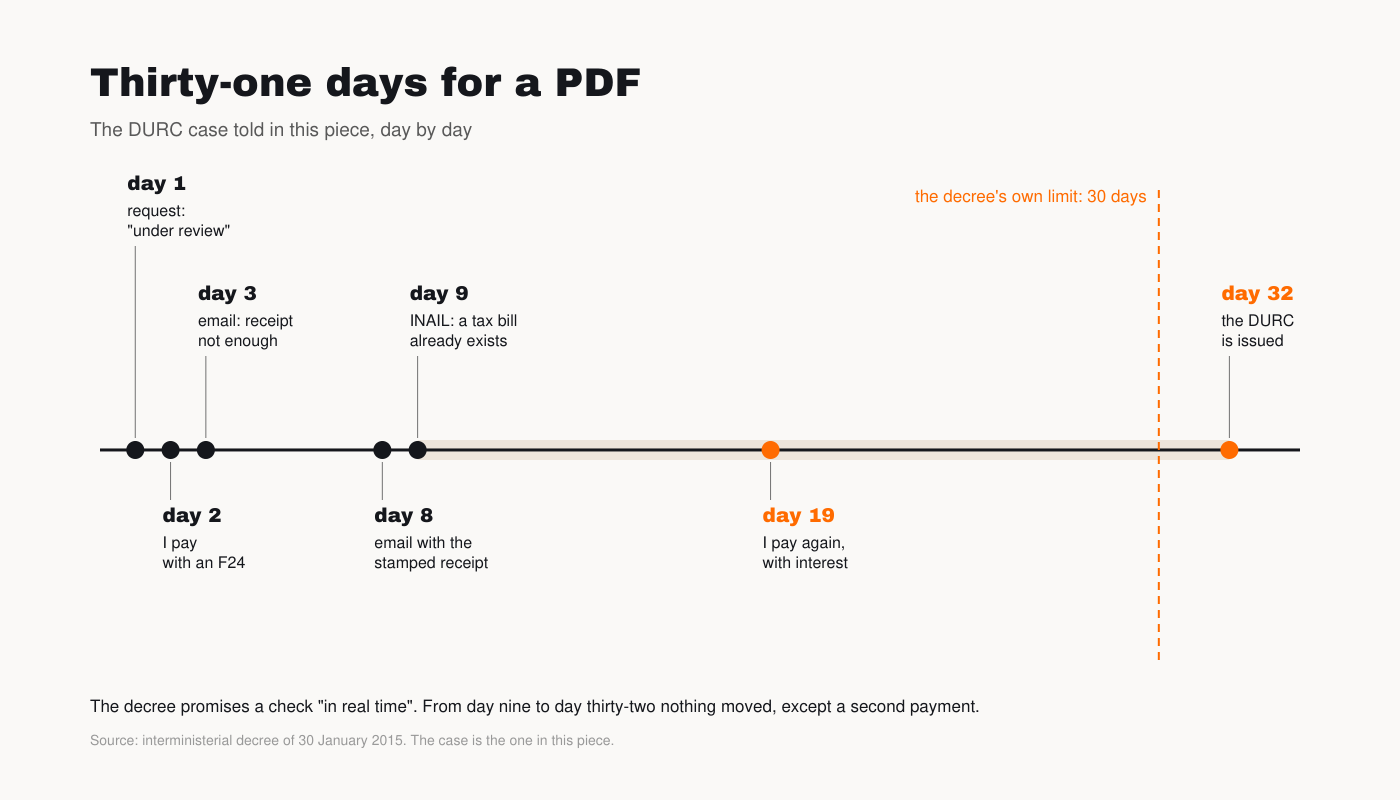
Day 1. I log into the portal with my digital identity and request the DURC. The answer is “under verification”. The reason sits with INAIL: an overdue premium, plus a penalty. The decree calls it an “invitation to regularise” and gives fifteen days to pay.
Day 2. I pay through the bank with an F24, the standard tax payment form. The F24 is the State’s own channel: the money goes through the Revenue Agency and reaches the insurer with a protocol number.
Day 3. I send the payment receipt to the local INAIL office by certified email. The office replies that the bank’s “authorised instruction” is not enough: it needs the quietanza, the receipt carrying the electronic protocol.
Day 8. I download the quietanza from the bank’s portal and send it again by certified email.
Day 9. The INAIL office replies. The same premium, with the same penalty, had already been entered on a tax collection notice served in February and handed over to the Revenue Agency’s collection arm. Since the notice had already been served, the office writes, the debt cannot be cleared, because the payment arrived after service. In plain words: I had paid the right amount to the right agency through the State’s own channel, but at the wrong desk of the same State.
Day 19. I pay the collection notice as well, with default interest and service fees. Then I write a third certified email: I ask for a refund of the first payment, or failing that a credit against next year’s premiums, and I ask someone to close the DURC verification. On day 19 the file still reads “under verification”.
Day 32. The DURC comes out: a one-page pdf saying the company is in good standing. The 2015 decree gives the invitation to regularise an effect “not exceeding 30 days from the query”: my verification took thirty-one. And the document is valid for 120 days from the date of the request, not from the day it is issued: it arrived with thirty-one days of validity already spent. Eighty-nine remained.
The tally
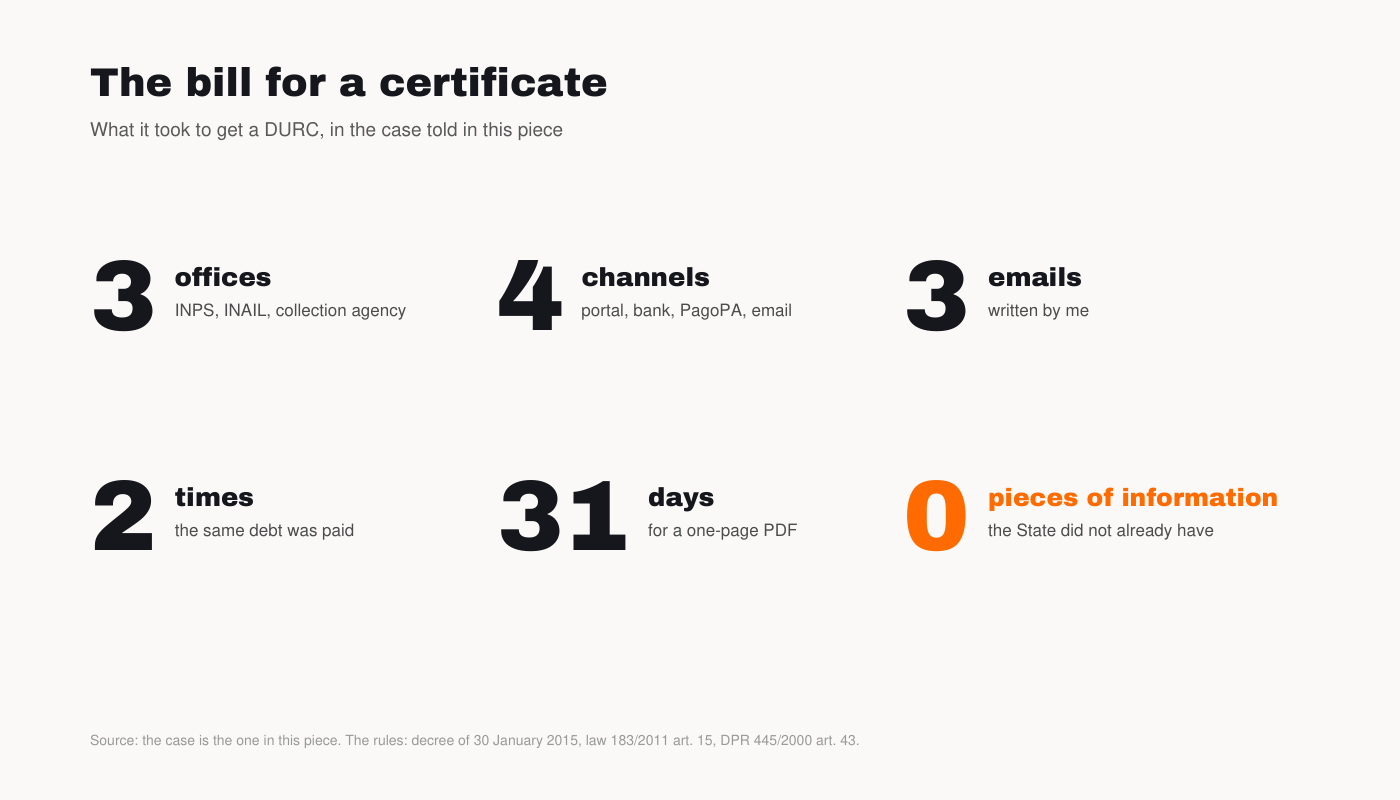
Three agencies: INPS, INAIL, the Revenue Agency’s collection arm. Four channels: the DURC portal, the bank for the F24, the public payments platform for the notice, certified email for everything else. Three certified emails written by me, two received. One debt paid twice. Thirty-one days, and a customer who waited a month for a pdf.
And a separate column, the one that matters: the pieces of information I gave the State that the State did not already have. None.
The State knew about the debt, because it wrote both the invitation and the collection notice. It knew about the payment, because the F24 runs through its own house and lands with its own protocol. It knew the invitation and the notice were the same debt: same premium, same period, same company. Each office knew its part. No system said a word to the system next door. The one carrying paper from desk to desk, at his own expense, was me.
The law already says so
On paper this has been forbidden for fourteen years. Since 1 January 2012, under article 15 of law 183 of 2011, a public office may not ask a citizen for a certificate about facts another public office already knows: it must obtain them itself, as article 43 of the consolidated law on administrative documents provides. Every certificate must state, on pain of nullity, that it cannot be produced to a public administration. A DURC requested by a private customer falls outside that rule on a technicality, but the substance is identical: the State certifies to itself that I have paid the State, and to do so it asks me to prove it. The European Union put the same principle into a regulation, 2018/1724 on the single digital gateway, and gave it a name anyone can understand: once only. You provide the data once.
How it should work
No document at all. A live compliance status, updated by the same archives that today are queried on request, visible to me and to anyone entitled to see it, the customer included, with one consent and one click. If something is missing, a notice with the amount and a button to pay. The status turns green the moment the payment enters the State’s channel, because the channel is already the State’s. The invitation and the collection notice are the same debt on a single ledger, so paying it twice becomes impossible. Nobody asks me for the receipt: they already hold it.
None of this needs a superior intelligence. It needs the dullest job there is: reconciling three archives that all talk about me and never talk to each other. That is the job today’s models do better than anyone, and the job a small business already does every evening on its own books, with tools that cost less than the service fees on one collection notice.
Who got it wrong
Nobody, by their own rules. The official who wrote that a notice already served cannot be cleared applied the rule. The portal that displayed “under verification” did what it was programmed to do. The bank issued the document banks issue. The sum of many correct behaviours is a business paying twice and a customer waiting for a pdf.
The responsibility sits upstream, with whoever designed the machine this way and leaves it this way. And it sits with those who, without meaning to, live off every extra step: a consultant who follows it, an office that processes it, a queue that justifies a headcount. Whenever someone says zero bureaucracy is a dream, those are the people being proved right.
No reform is needed here. The 2012 law exists, the European regulation exists, the archives exist, the technology is cheap. What is needed is a decision: the DURC is not requested, it is seen. My file closed on the thirty-first day, one past the deadline the decree set for itself. I kept the count, because the machine does not.