
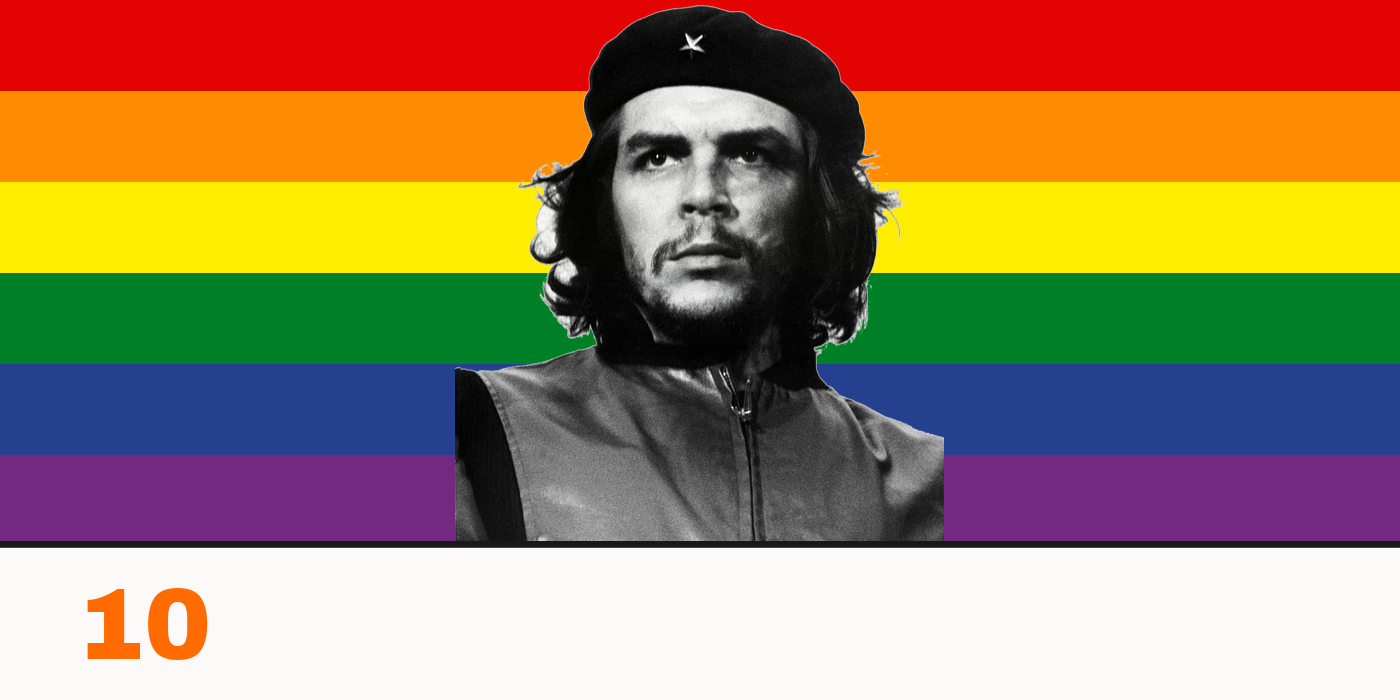
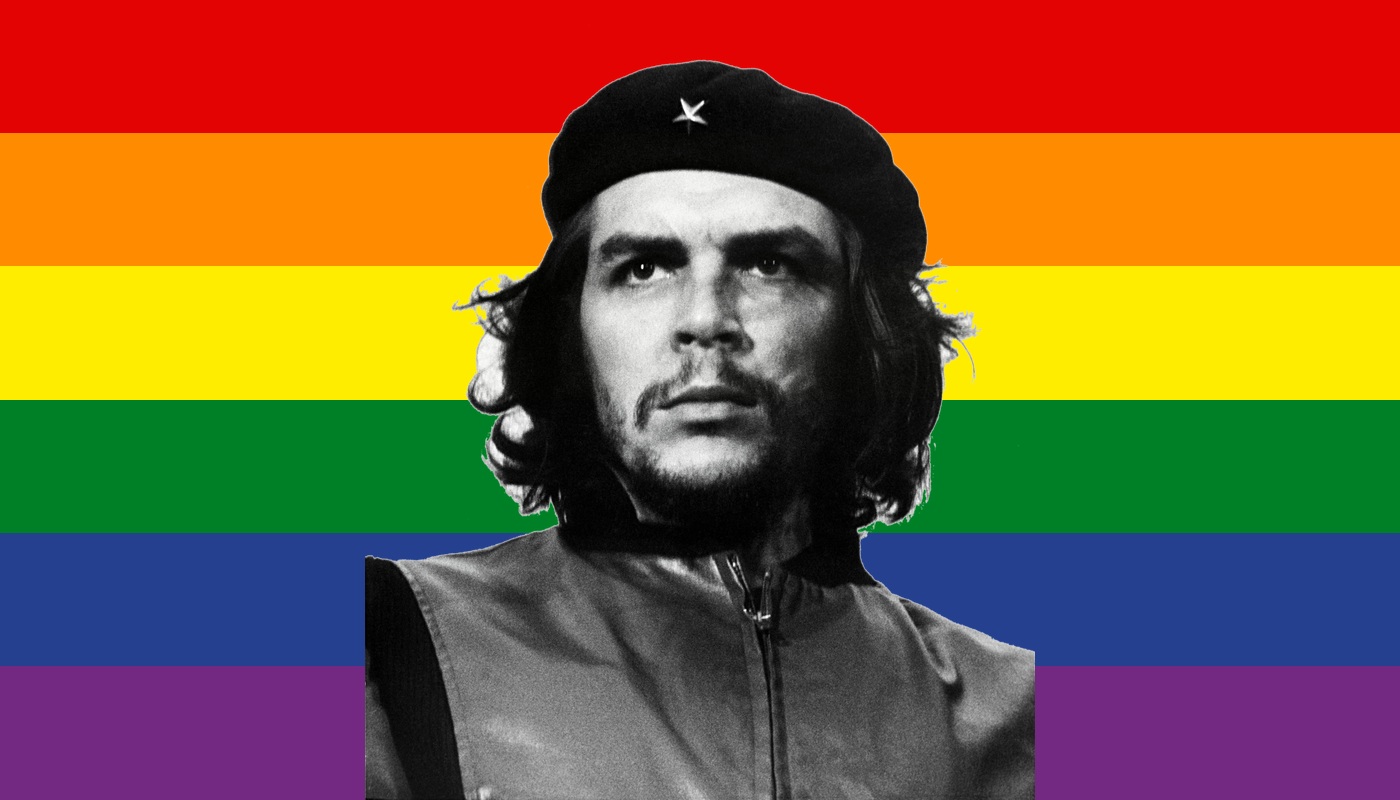
Every June, at the Pride marches, a few of them go by: a rainbow flag with Ernesto Guevara’s face printed on it. They sell online for a few euros, you can find one in ten seconds, and whoever carries it does so in perfect good faith, because they were taught that this face stands with the people who get shut out.
The man printed on that flag founded a labour camp. And when he was asked to account for what it was, he defended it in writing.
What «the new man» actually means
Those three words have a history much longer than Cuba, and it is worth knowing where they come from before going any further.
They come from Paul’s letters. There is the old man who is stripped off and the new man who is put on: whoever converts does not improve, he changes person, and what he was before comes off like a coat. Twentieth century socialism takes that figure, removes God from it and keeps the mechanism: there is a wrong man who must end and a right one who must begin.
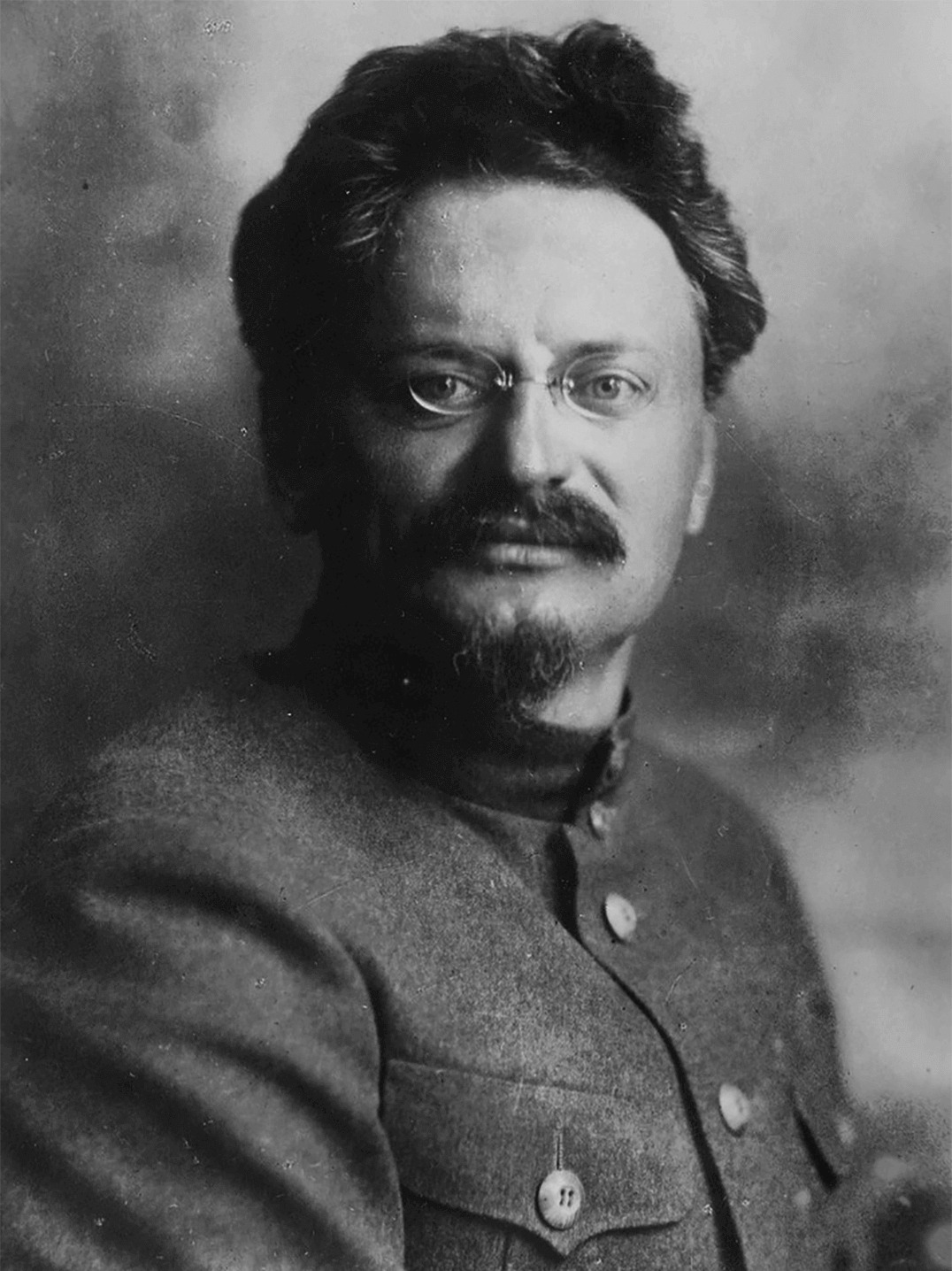
Trotsky writes it out plainly in 1924, in the closing lines of Literature and Revolution. Man will become «immeasurably stronger, wiser and subtler», his body more harmonious, his movements more rhythmic, his voice more musical, and «the average human type will rise to the heights of an Aristotle, a Goethe, or a Marx. And above this ridge new peaks will rise». He is setting production targets, and the material is people.
Guevara arrives forty years later. In March 1965, from Algeria, he writes a letter to Carlos Quijano, who edits the Uruguayan weekly Marcha, and Quijano publishes it on the 12th. The world knows it as Socialism and Man in Cuba.
Three sentences, his, from that text.
«Society as a whole must become a gigantic school.»
«Youth is the malleable clay from which the new man can be built.»
«The guilt of many of our intellectuals and artists lies in their original sin: they are not authentically revolutionary.»
There is not a word about homosexuals in that text. There does not need to be.
If society as a whole is a school, somebody is the headmaster. If the young are clay, somebody has their hands on it. And if there is an original sin, there is somebody who absolves it and something that expiates it.
The new man is a specification: it lays down what people must become. Whoever writes it, with the best intentions in the world, has just invented two jobs that did not exist before. The job of looking at people and deciding who resembles the model. And the job of taking charge of the others, in a place built for the purpose, because on their own nobody turns into somebody else.
From that moment on you do not need to hate anybody personally to arrive at the camps. You only need to apply the principle consistently.
The principle, and who brought it to Cuba
The principle has a precise shape, and it is not prison: whoever deviates is not punished, he is corrected through work.
Guevara did not invent it. In March 1934 the Soviet Union introduced article 121 of the penal code: male homosexuality became a crime again, and the sentence was five years of hard labour. Two months later, on 23 May, Pravda published an article by Maxim Gorky in which homosexuality was a bourgeois disease and a product of German fascism. The slogan was: destroy the homosexuals and fascism will disappear.
In 1960, newly appointed minister of industry, Guevara came back from a trip to China impressed by the work brigades, and ordered the building of the Guanahacabibes camp. It took in those who had committed offences against revolutionary morality.
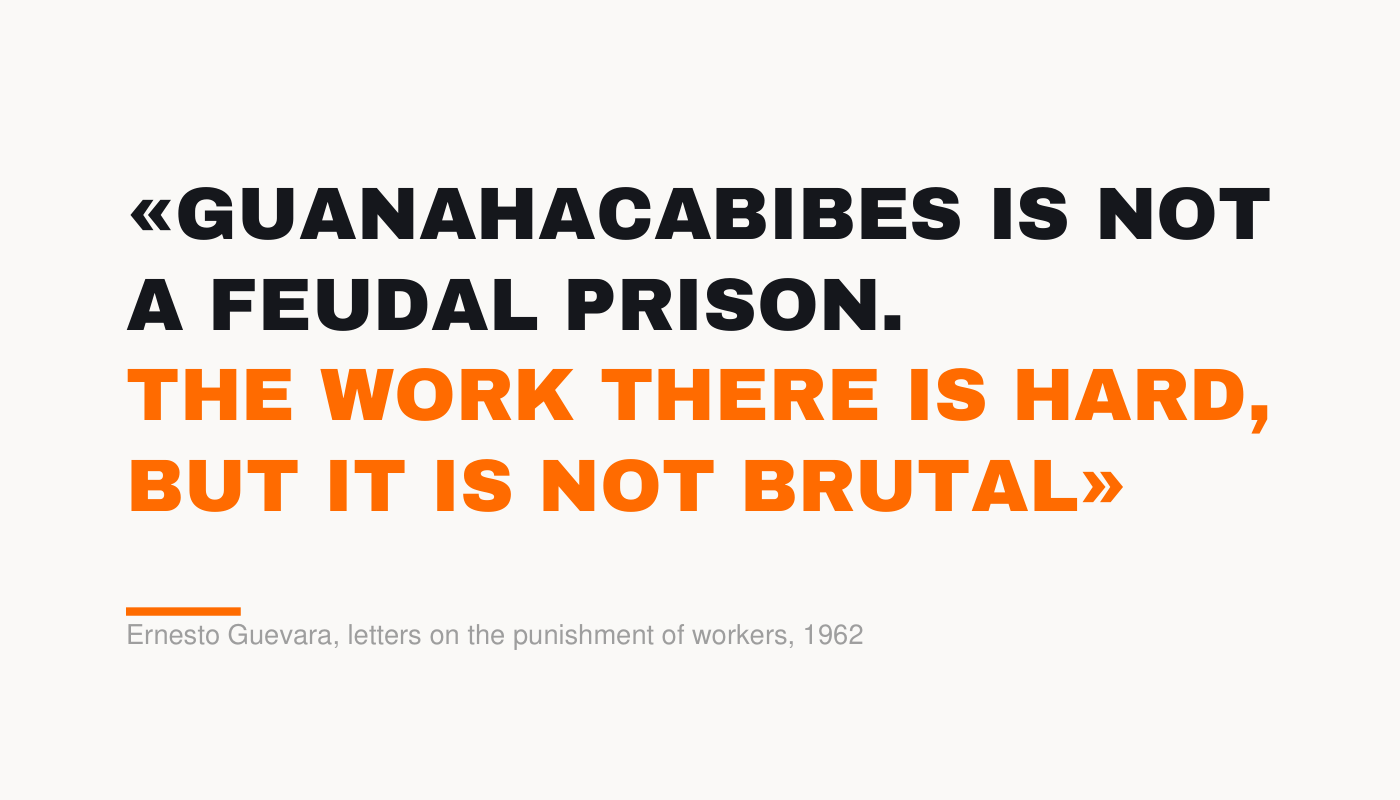
Two years later, in an exchange of letters with a company manager about punishing workers, he had to explain what that place was. He answered like this: «Guanahacabibes is not a feudal prison. We do not send to Guanahacabibes people who ought to be in jail. We send people who have committed a more or less serious offence against revolutionary ethics and have been dismissed from their job. The work there is hard, but it is not brutal.»
It is worth reading again slowly. He is defending a place he is careful to distinguish from a prison, and the distinction matters to him. Whoever ends up there has broken an ethic, not a law, and serves the sentence by working.
Guevara did not invent that recipe. He imported it. He is the one who installed it in Cuba, five years before anybody pointed it at homosexuals.
What happened next
In November 1965 the UMAP opened, the Military Units to Aid Production. They stayed in place until 1968 and thousands of people passed through them: homosexuals, Jehovah’s Witnesses, priests, intellectuals. The method was the same one: work straightens you out.
From 24 to 28 April 1971, in Havana, the First National Congress on Education and Culture put it down in writing. Homosexuality was a social pathology, and homosexuals were to be excluded from schools, from culture, from any role that brought them into contact with the young.
On 31 August 2010, in an interview with Carmen Lira Saade for the Mexican daily La Jornada, Fidel Castro took responsibility for it. The words are these: «A great injustice! Whoever did it. If it was us, us…» And he added that he was trying to define the limits of his own responsibility, because personally he did not hold that prejudice.
It is a sentence that breaks off on its own, and that is why it counts: it is the way a man of ninety two realises late what he let happen.
Ninety-two years, and not one of these steps is contested. They admitted them themselves.
The serious objection, and the answer
Anybody who knows the material has a good objection at this point, and it deserves to be taken whole: the UMAP were not Guevara’s. When they opened, in November 1965, he had already left Cuba for the Congo. He did not order them, did not run them, never saw them. Whoever pins them on him is saying something false, and whoever builds an argument on that falsehood deserves to be taken apart.
The answer is that this was never the point.
We are not interested in what he privately thought about who loves whom, and we do not need to attribute to him a camp he did not open. We are interested in the fact that he founded the principle: there is a right kind of man, there are those who do not look like him, and those who do not look like him are corrected through work. Whoever establishes that principle does not decide who will end up in the camps. He decides that there will be camps, and leaves it to others to fill them.
That is the part you cannot separate out. You can take the UMAP away from Guevara. You cannot take away Guanahacabibes, which dates from 1960 and carries his signature.
Where I stand, and since when
At this point it is fair that whoever is reading knows where I am speaking from, because without it the rest reads crooked.
On how a person lives, who they love, who they go to bed with and what they do with their life, my position is as wide as it gets. It is no business of the State and it is no business of mine. It was given to me at home, by upbringing, long before I had the words to explain it, and then I found it under my hands because of the work I chose. I worked in evening venues from the end of the eighties through the whole of the nineties, and nothing had to be declared there, because nothing was asked. Nobody came out, because nobody had to: everyone lived their own sexuality however they wanted, and it was nobody’s concession to grant. You worked together, you went out together, and whoever you were, you were.
Anybody who was there in those years knows it: everything was less sanctimonious. People said anything, took the mickey out of everything, and precisely for that reason nobody needed to prove anything. Freedom was practised, and it had occurred to nobody that it had to be displayed.
And when I say sanctimonious I do not only mean the priests and the families who did not understand. I include the sanctimoniousness of today, which has merely changed parish. There is a religion of rights with its dogmas, its correct words, its sins and its excommunicated, and like every religion it serves above all to separate those who are inside from those who are outside. It took the place of the old one and kept the same trade: telling people how to be in the world.
The paradox is that something born to include has ended up excluding. Get one word wrong and you are out, and you are out even if you never used that word to hurt anybody. In those places people said anything to each other and nobody was left outside. Now everybody is careful about how they speak, and whoever does not know the new vocabulary keeps quiet and goes home.
What happened is that this freedom turned into a position to be declared. And a position to be declared can be handed out, can be counted, and above all can be given instead of something else.
The new man was a promise about the future
Here is the thing that holds it all together, and it has nothing to do with Cuba.
The new man was not a description of the present. It was a promise about the future, and that is why it worked. Guevara was not asking for agreement about what he was doing: he was asking for credit against what was going to come. The men of today are building material, the real man arrives later. The clay is what he has in his hands, the statue will be seen by somebody else.
It is the oldest bargain in politics. I take your present and I give you the future. And since the future cannot be verified, the bill never arrives.
Who paid, in Cuba, we know: those who did not resemble the model. Whoever pays today in Italy does not end up in a camp, but pays all the same, and pays in the same currency. The future.
The future, in two numbers
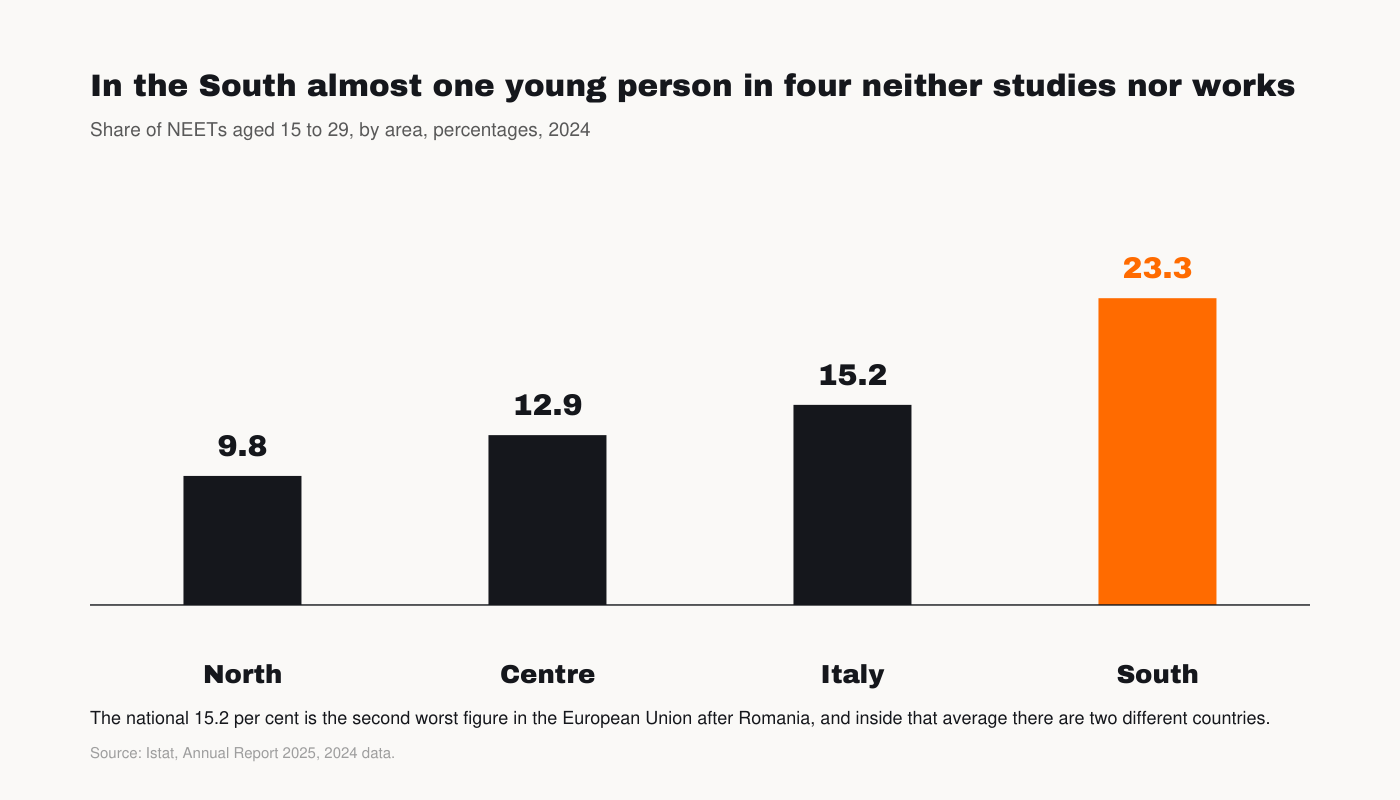
In Italy people leave their parents’ home on average at thirty years and one month. The European average is twenty-six years and two months: almost four years of difference, and these are Eurostat figures for 2024. 15.2 per cent of people aged fifteen to twenty-nine are not in education, employment or training: the second worst figure in the European Union after Romania, and in the South it reaches 23.3 per cent against 9.8 in the North. Those come from Istat, annual report 2025.
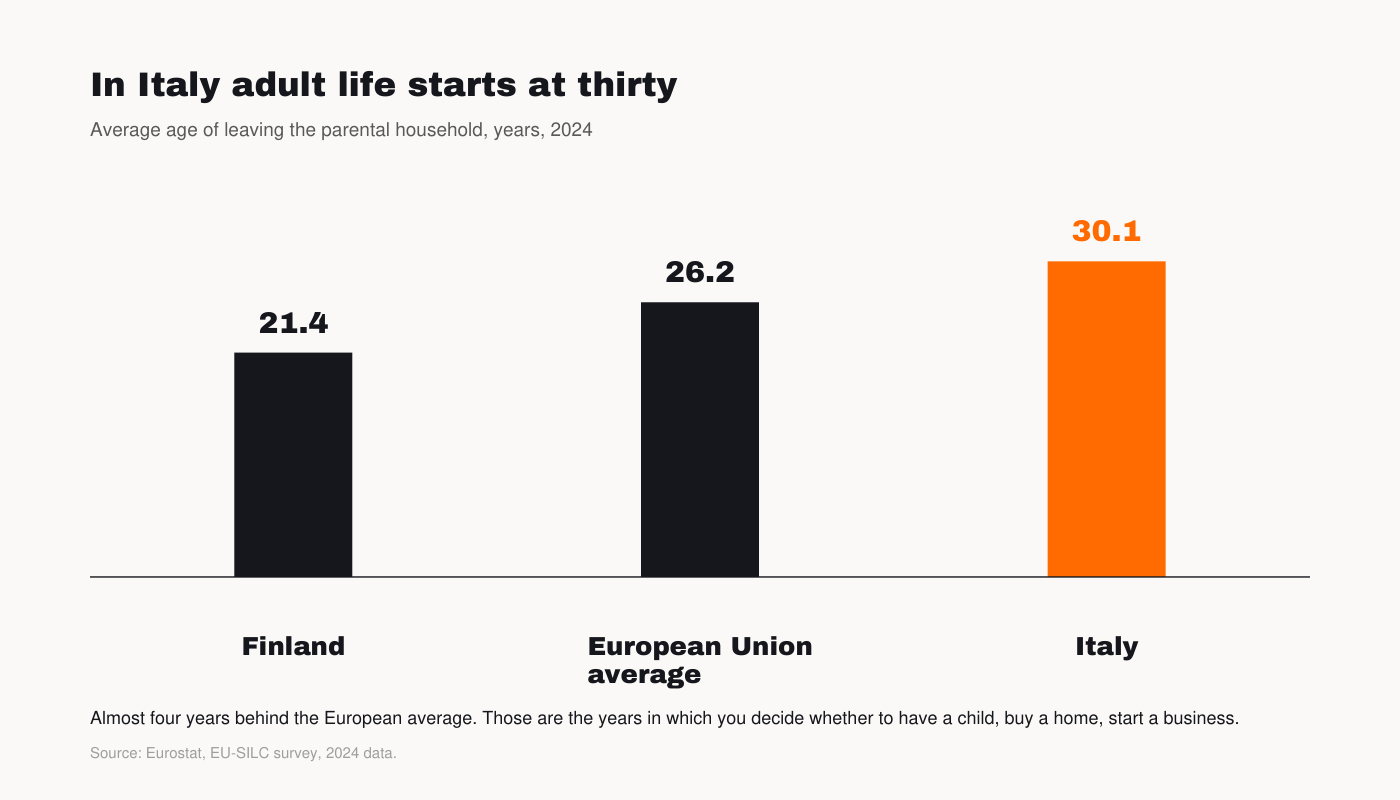
Behind those numbers there is no laziness. There is a life that starts four years late. Four years are the difference between having a child and not having one, between buying a home and renting for ever, between opening a business at twenty-seven and never opening one at all.
There is no flag that moves those numbers by a decimal point.
They are moved by contracts you can actually sign, homes you can actually buy, taxes you can actually pay, permits that arrive before the idea has died. These are things that cost somebody something: whoever holds the rent, whoever holds the position, whoever already has the job. And that is why symbols are handed out in their place.
And here comes the uncomfortable part, and I say it from where I stand.
I am not against the reforms that made the labour market more flexible. The Treu package of 1997 and the Jobs Act of 2015 took rigidity out of a system that had far too much of it, and anybody still defending article 18 as an achievement is defending a badly distributed guarantee, one that protects those already inside and has never done anything for those outside. The unions that live off that defence are part of the problem, not of the solution. I believe in merit, and merit needs a market that moves.
The problem is the half of the job that was never done afterwards.
Making a market flexible is half the work. The other half is building the conditions in which a young person, inside that market, can still put a life together: homes that can be bought, taxes that can be paid, permits that arrive, a system that rewards those who are worth it instead of those who wait their turn. Nobody did that half. And flexibility without the conditions has another name, which is precariousness.
While that half went undone, politics found a currency that costs nothing to spend.
Little more than a year separates the decree on the growing protections contract from the law on civil unions. Civil unions were a good thing and they had to be done, and those who did them did well: that law is not what I am talking about. I am talking about the fact that in those months a twenty five year old was granted the right to marry the person he loves, and was given none of the tools to build the life that marriage is supposed to sit inside. The first thing is announced at a press conference and takes nothing away from anybody. The second costs, and it costs those who already hold the job, the rent, the position.
The left carries a heavy responsibility, and not for having made those reforms. For having stopped caring about people’s material future at the exact moment it discovered that civil rights could be handed out for free. But the responsibility is not only its own, because everybody spent that currency: it suited everybody.
And the young were distracted, on a mass scale and successfully. Twenty years arguing about what things are called, about who may say what, about which flag goes up: arguments that can last for ever, because they carry no price and have no end. Those having them believed they were fighting the right battle, and in good faith they were. Meanwhile nobody was answering the only question that mattered, which is how you are supposed to buy a home and have a child at thirty in this country.
That is the part that angers me most. Not that they were given rights: that those rights served somebody else as a way of never answering for all the rest.
A symbol is free. It takes nothing from anybody, it makes nobody important angry, and it lets you feel on the right side this very evening.
That face survives for this reason. It is the cheapest costume in the world: you put it on and you are good, without having studied anything, without having given up anything, without having to argue with anybody.
The bill
There is nothing to reproach in the people who wear that face. Nobody ever explained it to them.
The bill goes to whoever sold it to them: to a political class that understood before anybody else that handing out identities costs nothing and building a future costs a fortune. They filled you with flags and emptied out your years.
And the paradox is perfect, because that is exactly what the new man did. Somebody decides who you have to become, asks you to work at becoming it, and the future stays permanently next year.
The opposite of a free man is a man who has been promised the future.