

I run a business in the restaurant trade in Milan, and my year with the tax authority starts on 16 January. On the 16th of every month I pay, on an F24 form, the tax withheld from my staff’s wages, their social contributions and the previous month’s VAT: twelve times a year, with no month off. And every single day each receipt goes off to the tax authority and each invoice passes through the State’s e-invoicing system.
Then come the dates of the year. On 16 February the workplace insurance premium. On 16 March the VAT balance, the annual tax on company books and a tax certificate for every employee. By 30 April the annual VAT return and the accounts, to be filed with the Chamber of Commerce. Four times a year the quarterly VAT report. On 30 June the balance of corporate and regional business tax, the first advance for the following year and the Chamber of Commerce fee. By 31 October the company’s income tax return, the regional tax return and the return listing every sum withheld. On 30 November the second advance, on 27 December the VAT advance.
It is money, but before that it is time. In the last World Bank and PwC survey, published in 2019, an average Italian company spent 238 hours a year preparing and paying taxes, and between taxes and contributions handed the State 59.1 per cent of its commercial profits, against a European average of 38.9. The series was then discontinued, but there is no reason to think things have improved: in 2025 Italy’s overall tax burden rose to 42.9 per cent of GDP, according to Istat.
I am not writing this to complain. It is the price of doing business here and I pay it. I am writing it because this calendar has one feature that matters for everything that follows: I cannot move a single day of it to another country.
Nor can the baker round the corner. The oven is on that street, the shop assistants are on Italian contracts, the takings go through a till wired to the tax authority. In a good year the baker pays more, in a bad year less, but where to pay is not up to the baker.

The same goes for someone in Chiavari, on the Ligurian coast, who lets two rooms by the sea. They pay VAT on every night. And for years, on that same night, someone else earned money without declaring anything in Italy: the platform that had brought the guest and taken its commission, invoiced from Amsterdam.
It was in Chiavari that the Guardia di Finanza, Italy’s financial police, started pulling the thread. According to prosecutors in Genoa, Booking.com was not paying Italian VAT on the commissions of private hosts letting a room without a VAT number, and did not even file a VAT return here. In November 2023 the company settled with the tax authority, paying 94 million euros for the years 2013 to 2021. It has always maintained it was compliant, and a settlement is not a conviction. For 2022, though, at the prosecutors’ request, it filed its first Italian VAT return: more than 19 million in a single year.
Gucci is the same kind of story, only bigger. The brand was born in Florence, and the bags were designed and sold in Italy. The company that sold them to the rest of the world, however, was in Cadempino, in the Swiss canton of Ticino, where those profits were taxed at around 8 per cent. According to Milan prosecutors the work that mattered, marketing and commercial decisions, was done in Milan, and the Swiss company was in fact an undeclared Italian establishment. In May 2019 the French group that controls Gucci settled with the Italian tax authority, paying 1.25 billion euros for 2011 to 2017, the largest sum ever agreed in Italy by a single company. A few days later it announced that the logistics it ran in Ticino, some three hundred jobs, would move back to Italy. Swiss public broadcasting estimated that the canton, its municipalities and the Confederation would lose between 50 and 80 million francs of tax a year.
The money Ticino lost shows that when a rule is actually applied, profits go back to where the customers are.
How big the gap is
Booking and Gucci came to light because someone spent years looking for them. The rest can only be estimated. According to the Tax Justice Network, in the most recent annual estimate available, Italy loses 11.19 billion dollars of tax a year: 8.23 billion from profits that multinationals shift abroad, close to 30 billion dollars of profit, and 2.96 billion from private wealth held offshore. The same institute calls it an underestimate, because it only counts profits that end up where the rate is below 15 per cent. It is worth half a point of GDP, more than 7 per cent of what Italy spends on health care every year.
Nor is this only about the American web giants. In its following edition, covering 2016 to 2021, the Tax Justice Network split the tax Italy lost by the country of the parent company: only 14 per cent came from American groups. The rest belongs to groups headquartered elsewhere, and Gucci, owned by a French group, is there to remind us.
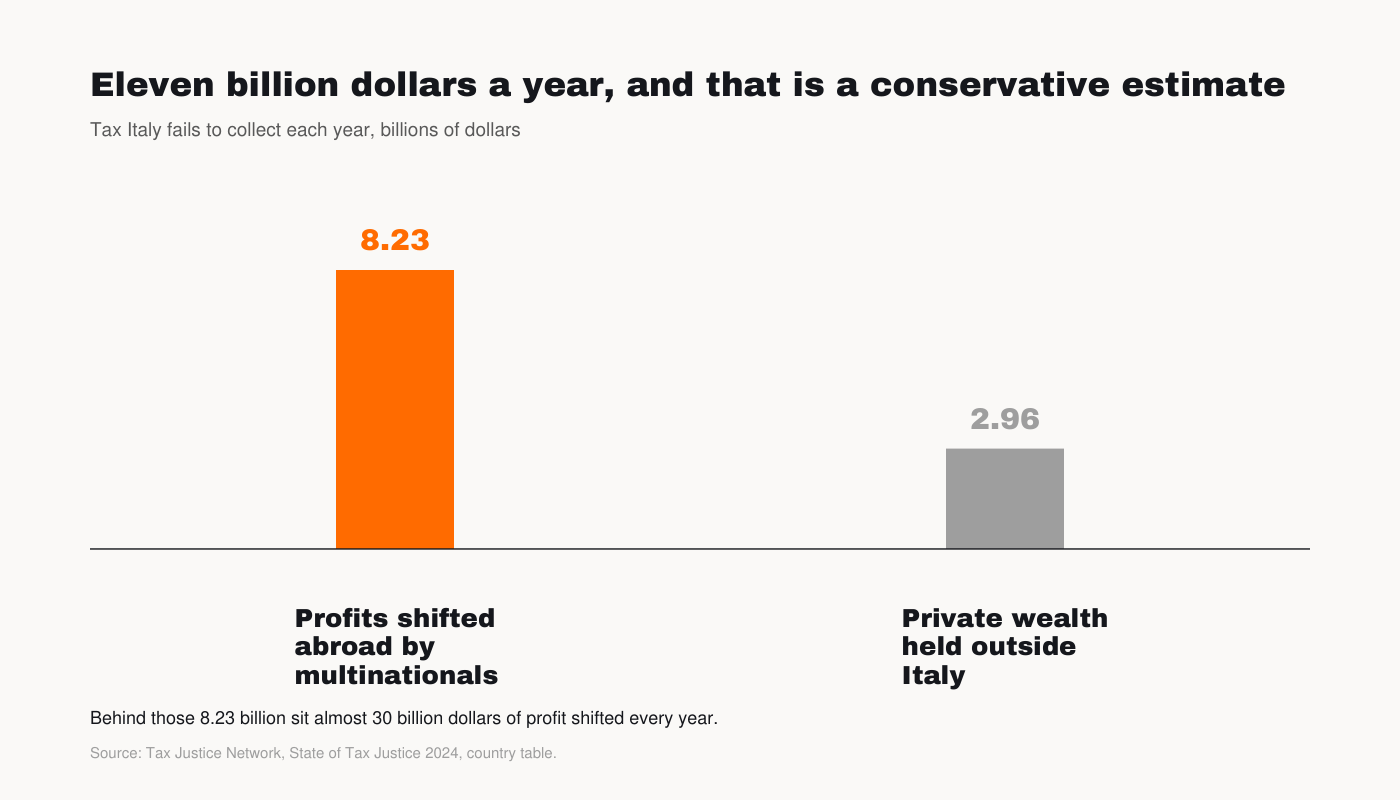
Two different things, and they should not be mixed
That figure contains two phenomena that cannot be governed in the same way.
Part of it is finance: holding companies, treasuries, trademarks, patents. These activities have no natural home. They can sit in Luxembourg as easily as in Ireland, and whoever moved them to pay less will move them again as soon as the rules change. There is little point chasing them. Hardly anyone puts them in Italy because it is not worth it, and a country where it is worth staying attracts them without needing anything else.
The other part does not run away, and it is the part we saw in Chiavari and Milan. Whoever sells here has the shops, the warehouses, the staff and the customers here, and invoices elsewhere. In 2022 the Italian subsidiaries of the big web groups reported 9.3 billion euros of revenue and paid 162 million in tax, according to Mediobanca’s research department. The customers are in Italy and they do not move. The principle is simple and requires no new tax: whoever sells in Italy pays in Italy.
The global reform, year one
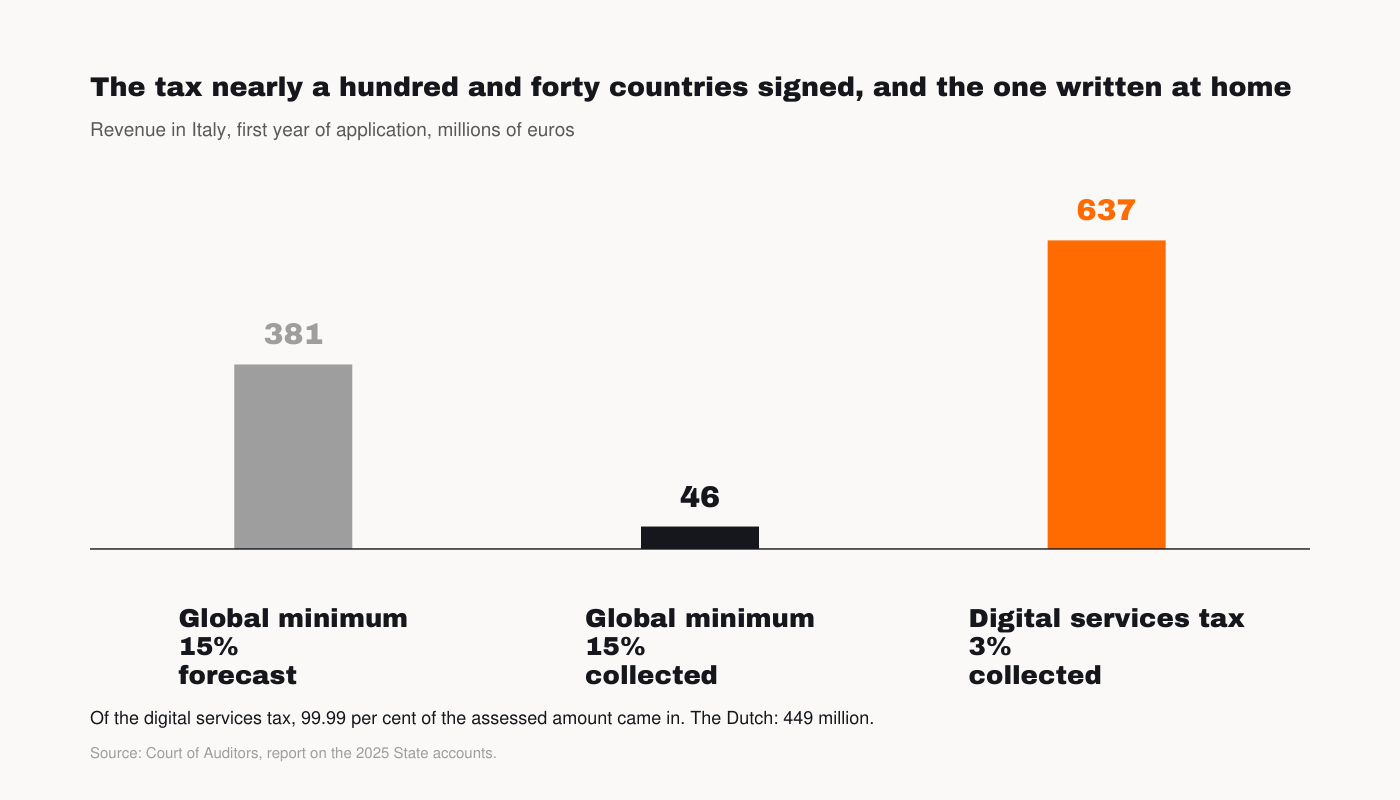
To close the gap, in 2021 nearly a hundred and forty countries agreed at the OECD on a minimum tax of 15 per cent on large groups. In Italy the first year was supposed to bring in 381 million euros. It brought in 46, 12 per cent of the forecast, according to the Court of Auditors’ report on the 2025 State accounts.
In the same first year the Netherlands, a country with less than a third of our population, collected 449 million: ten times as much, and the figure may still change because Dutch filing deadlines were pushed back to the end of October. The Dutch are no stricter than us. The minimum tax simply works like this: it is largely collected by the country where the group’s parent company sits. The Netherlands hosts head offices, and Booking invoices from Amsterdam too. We host customers. We signed up to a rule written for countries that have the head offices.

One explanation works against us, and it is fair to give it. According to a working paper by the Finance Department, firms that were below 15 per cent increased their corporate and regional tax payments by 108 per cent, probably to avoid falling within the minimum. Part of the revenue, then, arrived by another route. The fact remains that the great international construction brought Italy 46 million in direct revenue.
What did work
Over the same period an Italian tax did the opposite of what everyone expected. It is the digital services tax: 3 per cent of what large groups earn in Italy from online advertising and from platforms that bring sellers and buyers together. It only applies to companies with more than 750 million euros of turnover worldwide. In 2025 it brought in 637 million, 40 per cent more than the year before, and it is the third year running that it has beaten forecasts.
Then there is the figure that explains everything else. Out of 637,072,986 euros assessed, 637,025,017 were paid. Forty-eight thousand euros are missing out of six hundred and thirty-seven million: 99.99 per cent came in with no litigation, no assessments, no ten-year court case.
The reason lies in how it is built. It does not ask where anyone is tax resident and takes no interest in where the head office is: it looks at where the user is. The Italian user is in Italy, and no corporate structure can move them. Anchored to a fact that cannot be moved, the tax collects itself.
It has three flaws, and they are real ones. It hits revenue rather than profit, so it is also paid by a company that lost money that year, and for a liberal that matters. It applies only to digital business, and Gucci was not a digital company. It exposes the country to trade retaliation from whoever hosts those firms. As it stands it should not be copied. But it proves a principle: a tax anchored to where the customers are gets collected, one anchored to where the head office is gets collected by somebody else.
We can do better
The first thing costs nothing and is already law. Under legislative decree 128 of 2024 large groups must publish their accounts country by country: turnover, profit and tax paid in each jurisdiction, filed with the business register and posted on their own website, free for anyone to read for five years. The first deadline is 31 December 2026, eleven weeks from now. Italy got there fifteen months after the European deadline, with infringement proceedings opened by the Commission. What it asks for is information, not a new tax and not extra paperwork for small firms: below 750 million euros of consolidated revenue nobody has to do anything. According to the same Tax Justice Network, had those accounts been public Italy would have recovered 6.16 billion dollars over six years. And the first to gain is whoever already plays by the rules, the room-letter and the baker alike, who today compete against someone they know nothing about.
The second concerns method, and it asks the State to move early rather than late. Today an undeclared establishment is discovered at the end: the tax authority contests seven years of tax all at once, with Gucci as with Booking, it drags on for years and ends in a settlement. For the State that is revenue arriving late. For a company that wants to invest here it is the worst of all worlds, because it does not know what it owes until the assessment arrives. A preliminary procedure has existed since 2017, but it is reserved for foreign groups with more than one billion euros of worldwide revenue and more than 50 million of sales in Italy: it should be opened at far lower thresholds, with an answer within months and binding on both sides. A company that asks in advance what it owes should not be treated as a suspect.
The third is the general rule that holds the other two together. Taxes should be anchored to facts that cannot be moved: where the customers, the staff, the warehouses and the rooms by the sea are. Every time they are anchored to a document signed before a notary in another country, the rule being written rewards whoever has twenty companies and punishes whoever has one.
And a fourth thing, which concerns trust rather than collection. What is recovered from those who were not paying should be returned to those who always paid, in the form of lower rates. Until that happens, the fight against tax evasion remains a tax increase that nobody declares.
Until now the rule has been the one in the headline: whoever cannot move pays and keeps quiet. In eleven weeks those accounts become public, and from that day we will know, group by group, how much each one sells in Italy and how much it pays here. Anyone who then wants that publication postponed, or watered down, or filled with exceptions, will already have explained why. Meanwhile we go on paying. But we have stopped keeping quiet.