

Let us start with a number that has nothing to do with right and wrong. It has to do with administration.
Domenico Zuccarella was 59 and had secondary progressive multiple sclerosis. On 8 November 2025 he asked the Ovest Milanese health authority for access to medically assisted suicide, something the Constitutional Court had granted him since 2019. He died on 25 August 2026. Between the request and the answer, 290 days went by, nine and a half months. It was the third case in Lombardy, but the first handled entirely by the regional health service: staff, drugs, equipment, premises.
And here comes the part that cannot be dismissed as polemic, because the number to compare it with was not chosen by a newspaper. On 13 May 2026 the Lombardy Region gave itself guidelines, and in those guidelines it wrote a maximum limit of 145 days, four months and three weeks. Two hundred and ninety is double that.
It should be said honestly that Zuccarella’s request dates from the previous November, so the process had already begun when that limit was written. But the point still holds, and in fact it moves to where it matters: the Region has already accepted the principle that there must be a deadline. There is nothing left to argue about whether. What is left to argue is whether that deadline is a commitment someone must meet, or a good intention an office can change at will.
Anyone who holds a position on this matter, and more than one position is legitimate, should stop for a moment on those two numbers. They do not say whether it is right or wrong that the question can be asked. They say that, once the law says it can be asked, the answer takes twice as long as the administration itself considers acceptable.

That this is not fate, Veneto shows. Stefano Gheller, from Cassola in the province of Vicenza, muscular dystrophy and a respirator twenty-four hours a day, filed his request with Aulss 7 Pedemontana on 30 June 2022 and was told on 13 October that it had been granted: three and a half months. He said at the time that he did not want to die straight away; he wanted the right to decide when.
This piece is not about whether. It is about how, and about who decides.
What happened in Veneto, and the number nobody puts in the opening line
On 2 September the Regional Council of Veneto approved a citizens’ initiative law setting out procedures and timeframes for regional healthcare assistance in medically assisted suicide. Thirty-two in favour, five abstentions, fourteen against. It is the fourth Region after Tuscany, Sardinia and Emilia-Romagna, and the first governed by the centre-right. Brothers of Italy voted against; the law passed because the opposition backed it too.
And it is worth listening to the man who carried it through, because he dismantles the most repeated accusation himself. Luca Zaia, now president of that Regional Council, explained the law like this: “this law does not introduce end of life and does not create a new right”, because “the perimeter was drawn by the Constitutional Court”. That is not an excuse: it is an exact description of what a Region may do and what it may not.
Then he gave the example that is worth more than any theoretical argument. Veneto, he recalled, ranks first in Italy for palliative care: it is not a Region that ignores the suffering and takes the shortcut. “But if someone at the terminal stage of their illness asks to be able to manage their own end of life, I believe it is right to let them manage it. Through a public facility.”
The two things together, palliative care at its best and a public procedure for the very few extreme cases, are the answer to those who say one excludes the other. In Veneto they coexist, and a centre-right administration makes them coexist.
Zaia added two remarks that concern Rome more than Venice. That the vote has “a double value: respect for terminally ill patients who are waiting, and a strong signal at national level, so that Parliament legislates”. And that “sooner or later this country will have to find a way through, and do it”. On how, he was blunter still: “in a democratic country there is freedom of conscience”, and with freedom of conscience and a secret ballot “we would have some surprises”. Without putting, he specified, “anyone in the dock”.
In reporting the news almost everyone led with the political alignment. The more interesting number had come from Zaia himself, and it sits at the bottom of the articles: in Veneto the requests have been 31 since 2019, and three received authorisation from the ethics committee. Seven years, 31 people, three cases.
This has to be said carefully, because it is easy to misuse. That number does not say the question is small: for those 31 people and their families it was everything, and no number captures that. It says something else, and it concerns those of us who argue about it: politics is debating a symbol with the intensity of a clash of civilisations, and the thing being debated concerns very few people in extreme circumstances.
The real question is not whether, because someone else has already answered that
Here we need to be precise, because this is where almost every commentary slips.
None of these regional laws creates a right. The right, within the narrow limits it set, was recognised by the Constitutional Court in 2019 and restated in 2024. Parliament, since then, has not written the law the Court asked it to write. In the vacuum, some Regions have written the procedure.
And the Court has returned to mark the boundary, twice, on 24 July this year, in two decisions filed the same day that point in different directions.
In judgment 148, on Sardinia’s law, it confirmed that Regions may act on organisational and healthcare aspects, because these fall under the protection of health, but may not touch the substantive requirements for access, which remain with the State. In its own words, regional legislation cannot claim to operate in a supplementary manner to state legislation, “taking possession of” the ordering principles the Court itself identified.
In judgment 152, the same day, it said no to any widening: the vital-support requirement stays where it was.
And the year before, in judgment 204 of 2025 on Tuscany’s law, it had already done the same thing: it struck down several provisions for encroaching on state competence, but left standing the organisational and procedural framework, which is concurrent competence. Among the things that fell were precisely the rigid, predetermined timeframes for the stages of the procedure.
Which is why the Veneto law just approved, the one with timeframes in its very title, does not contain those timeframes: it was written to fit inside that judgment. A law called “Liberi subito” reached port unable to promise the subito.
The reasoning is worth reading to the end, because it concerns us too. The Court says two things. The first is clinical: verifying the requirements calls for assessments that may not fit inside tight deadlines. The second matters more: if every Region sets different deadlines, response time ends up depending on where you live, and at that point it is no longer organisation. Only Rome can write days that are the same for everyone.
The picture that emerges is this: Regions may organise, they may not decide who is entitled to what. The Court is holding the line on substance and opening on organisation.
The case against, in full
At this point comes the thing almost nobody does in this debate, which is to report in full the objection of those who are against, without setting it up to be knocked down.
Antonio Brandi, president of Pro Vita e Famiglia, reacted to the Veneto vote by saying that “an attack on life has been carried out, and a cowardly betrayal of citizens by some centre-right councillors, whose voters have discovered today that they voted for a progressive and radical majority”. Alberto Stefani, president of the Veneto Region, claimed credit for working with his majority on amendments that change the text “in the direction of favor vitae”, prefacing this by saying that “nothing is more important than the dignity of human life, which must always be protected”.
Behind the harsh words there is a serious objection, and it is not only moral: it is empirical. Those against fear that a public procedure, once written, shifts over time the threshold of what is acceptable. It is a prediction about facts, and like all predictions about facts it can be checked by looking at the countries that legislated before us.
So let us look, and say what they show.
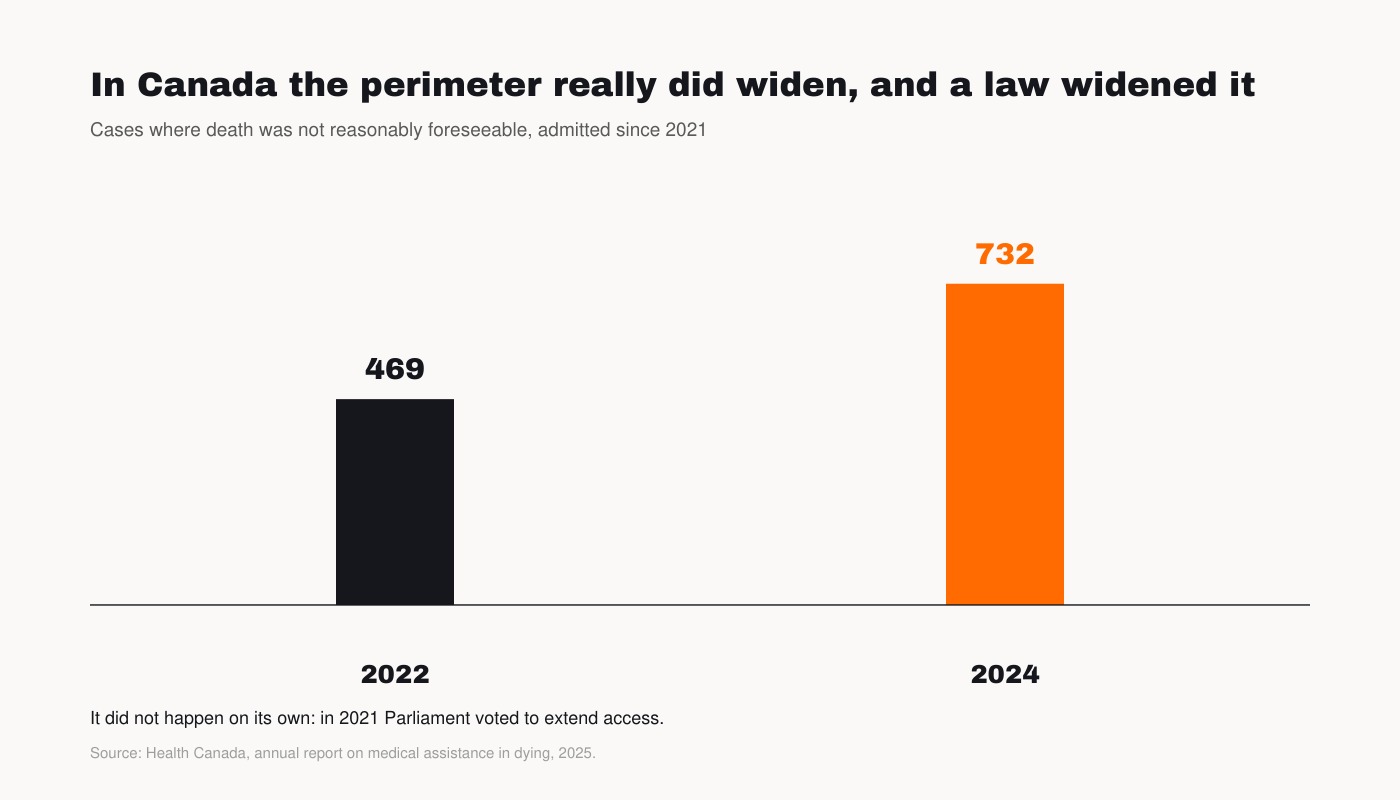
Canada proves the fear right. In 2024 there were 16,499 people, five per cent of all deaths in the country, and almost eight per cent in Quebec. And above all: in 2021 the Canadian Parliament extended access to people whose death is not reasonably foreseeable, going from 469 cases in 2022 to 732 in 2024. A second extension, to people whose sole underlying condition is a mental illness, is already scheduled for March 2027. Anyone saying the perimeter has widened is not imagining it: it happened.
Oregon proves the same claim wrong. The law dates from 1997 and the requirements are written into it: adult, capable of deciding, terminal illness with a prognosis within six months. After 28 years those three are still the ones. The only substantial change, in 2023, removed the state residency requirement, which widens the geography and not the clinical criteria. In 2025 there were 637 prescriptions and 400 deaths.
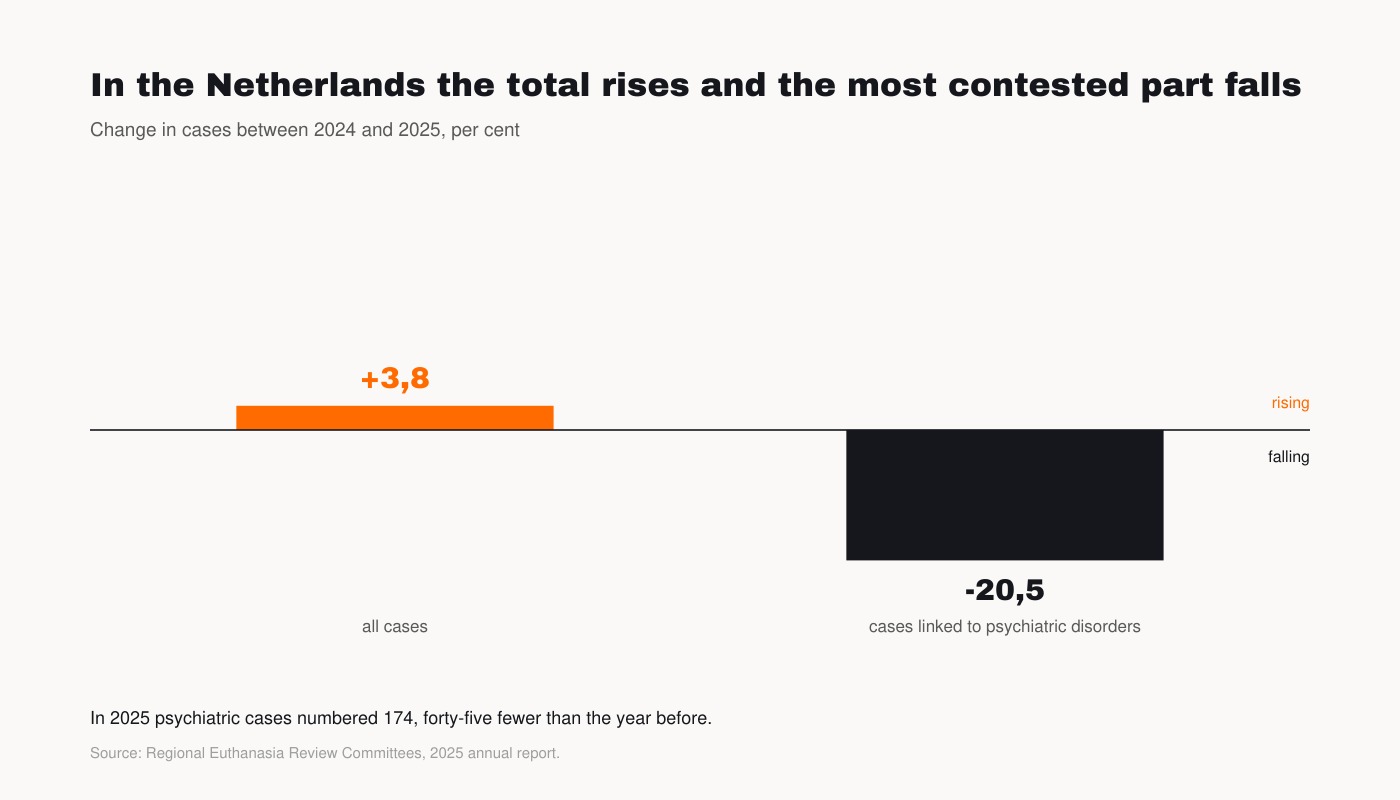
And in the Netherlands there is a figure neither camp cites. In 2025 total cases rose to 10,341, six per cent of all deaths. But those linked to psychiatric disorders, which is exactly the category the fear concentrates on, numbered 174, forty-five fewer than the year before, almost 21 per cent down. While the total was rising, the most contested part was falling.
The honest picture is this: the number grows everywhere, and that in itself proves nothing, because it is what happens to any right once people find out it exists. What actually changed, in Canada, are the requirements, and they changed because a parliament voted to change them.
Which is why the objection, serious as it is, does not bear on what a Regional Council debates. In Italy the substantive requirements are written neither by a Region nor by a health authority: they were set by the Constitutional Court, which in July, in judgment 152, has just refused to widen them. The lever that widened things in Canada does not exist in Lombardy. It sits in Rome, and whoever holds it has said no for now.
And so, Lombardy
On 19 November 2024 the Regional Council of Lombardy had before it a citizens’ initiative bill, brought by the Liberi Subito committee with 8,000 signatures. The centre-right majority tabled a preliminary objection of constitutionality, arguing the matter was not within regional competence. It passed with 43 votes in favour and 34 against.
The outcome was not that the bill was defeated. The outcome is that it never reached the floor. Eight thousand Lombard citizens used an instrument the regional Statute puts at their disposal, and the answer was that the subject is not to be discussed. President Attilio Fontana commented that “national action is certainly needed, there are no doubts”, and that “the Assembly is sovereign, so I do not think there is anything to add”. The Brothers of Italy group leader Christian Garavaglia claimed to have stood “on the side of life, and for promoting palliative care and pain therapy”. The Council of State later established that the decision cannot be reviewed by a judge: a Region may stop a citizens’ initiative bill without discussing it in the chamber.

One man, though, voted against, and he sat in the majority. Giulio Gallera, Forza Italia, formerly the Region’s Welfare councillor, was the only member of the centre-right not to vote for the preliminary objection, and he backed the minority report: that bill was not about the right, which the Court’s judgments had already recognised, but about the healthcare procedures by which a person in certain conditions may access it. Which is exactly the distinction the Court would put in writing a year and a half later.
Formally, everything in order. Politically, something does not add up.
What Lombardy has already done, and nobody reports
Because there is a part of this story that has to be told, and told in the Region’s favour.
President Attilio Fontana has repeatedly declared himself in favour of an end-of-life law, and not only a national one. In February 2025 the first case of medically assisted suicide took place in Lombardy, and Fontana set it out himself before the Regional Council rather than leaving it to the press. It cost him a clash inside his own majority, with Brothers of Italy openly contesting the choice.
And above all: on 13 May 2026 the Region gave itself guidelines, a written pathway saying who does what and within what time. That is not nothing, and it is more than sixteen Regions out of twenty have done. On 3 September Fontana claimed credit for it: Lombardy does not need a law because the guidelines are already there, and they have proved “functional, efficient and effective”, and what is missing is if anything the national law.
On one thing he is entirely right: the national law is missing, and we have been waiting for it since 2019.
On the rest, the problem is that those guidelines contain a number, and that number tells us whether they were effective. One hundred and forty-five days, the maximum the Region wrote with its own hand. The only case handled entirely by the Lombard health service required 290. Double.
This is not an accusation against Fontana, who on this matter has held a more open position than his own side. It is an observation about what a guideline is: an administrative document that sets a deadline and provides for nothing to happen if that deadline is missed. A regional law, the one the Council refused to debate, would do the same thing with one difference: someone would have to answer for it.
What Lombardy should do, and why it holds for those against too
The proposal is simple and asks nobody to change their mind.
Let the Regional Council debate that bill on the floor, and then vote as it sees fit. Against, if it wishes. A vote against is a legitimate political position, taken in front of the voters and defended. A preliminary objection that prevents debate is not a position: it is a way of not taking one.
Those against should want this most of all. If the reasons of favor vitae are strong, and some believe they are, they are better made in the chamber, said to the face of those who disagree, than behind a competence technicality the Court has contradicted twice. Veneto did exactly this: the centre-right majority debated, amended the text in the direction it thought right, and then voted. One may agree with the result or not. The method, though, is that of people taking responsibility.
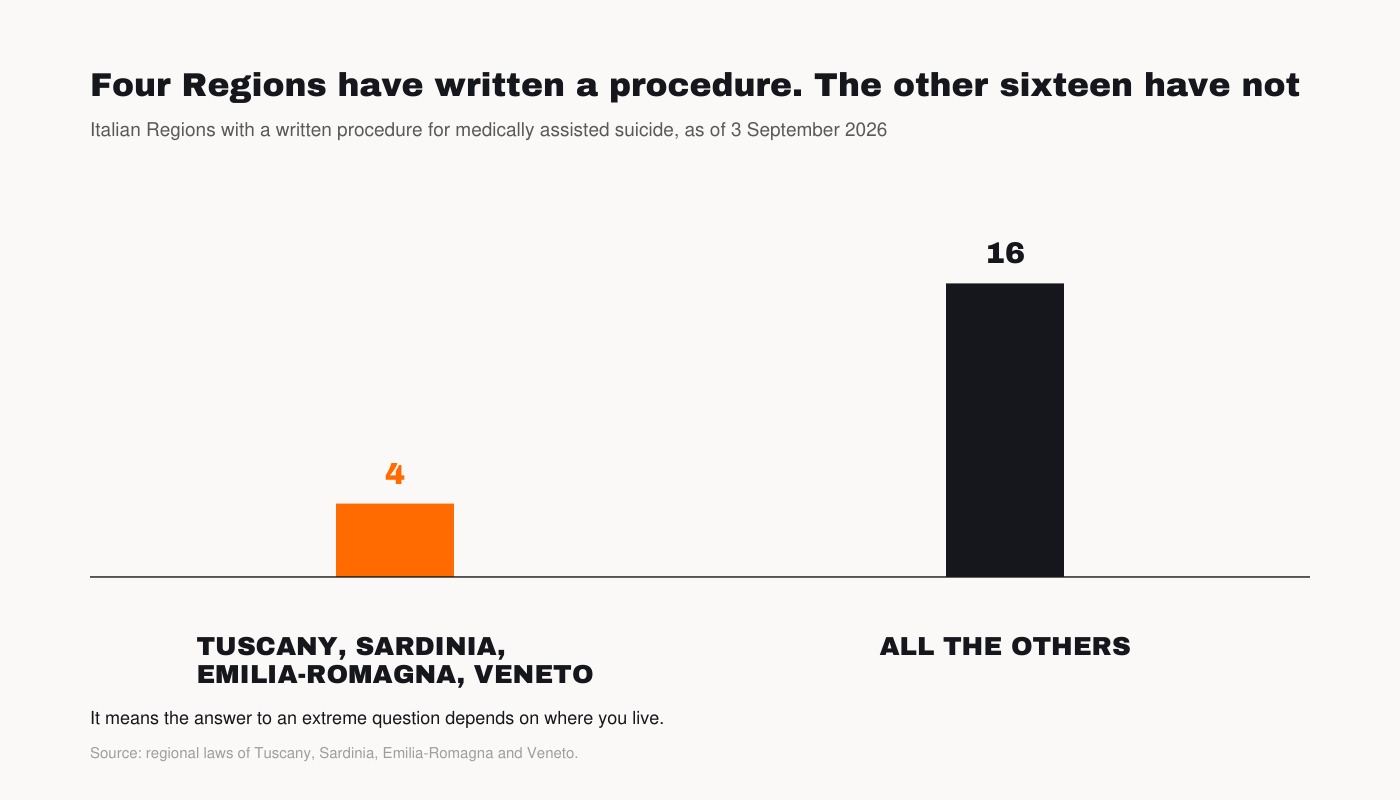
And there remains the thing that ought to trouble anyone, whatever side they are on. In Italy today four Regions out of twenty have a procedure and the others do not. It means that the answer to an extreme question, asked by a person in the most fragile condition a person can be in, depends on where that person lives. There is no idea of equality, secular or Catholic, liberal or solidarist, that can find this acceptable.
And in Rome, meanwhile, something is moving
In 2024 Fontana replied that national action was needed. He was right: it is. What is new is that someone is now trying, and it is not the opposition. The Forza Italia group leader in the Senate, Stefania Craxi, has announced that at the first meeting of group leaders she will ask for the end-of-life bill to be scheduled, and she justified it in words that could sit in this piece: it is Parliament’s duty to fill the legislative vacuum and avoid a chaos in which every Region goes its own way with different rules. From the Democratic Party, which has had its own proposal stalled for some time, Francesco Boccia replied that they are willing to support the scheduling, while setting a substantive condition about the role of the public health service.
It is not a law passed, it is a calendar slot requested. But it is more than has happened in seven years, and it moves the question where it belongs: Parliament writes the requirements, the Regions write the organisation.
There is then a fact that will settle itself over the next sixty days. The Government challenged Tuscany’s law and Sardinia’s law before the Constitutional Court: those two challenges are where the two judgments discussed above come from. Now the fourth law is made by a Region governed by the same majority that governs in Rome. If this one is challenged too, the line is consistent. If it is not challenged, it will mean the criterion was not a legal one. No position is required: one only has to watch.
Said by someone who sat in that chamber
I was a regional councillor in Lombardy from 2018 to 2023 and I chaired a committee. When the preliminary objection was voted, in November 2024, I was no longer there: I have no credit to claim and no vote to defend. But I know how that chamber works, and I know what it means to face a matter on which your group has a line and you have a conscience.
Anyone who is elected has a duty, and it is to take a position. It is not a detail of the job: it is the job. On almost everything one can, and often must, stay within group discipline, because that is how a majority governs. But there are matters on which that discipline has no standing, because you are not voting on a tax rate or a zoning plan: you are voting on how a person may die. There, the only allegiance that counts is to yourself. Zaia put it better than I would: in a democratic country there is freedom of conscience, and with freedom of conscience we would have some surprises.
So let me say it without hiding behind the method I have used throughout the rest of this piece: I would have supported that law. Not because I think life is worth little, but for exactly the opposite reason. Anyone with a deep respect for human life also has respect for the person who lived that life, and for the choice they make when they have reached the end of a suffering that none of us, from the outside, is able to measure.
There is an old word that says this better than the ones we use today, and it is pietas. It is not pity, which looks down from above. It is the respect owed to what does not belong to us: to others, to their bonds, to their way of ending. Pietas does not decide for anyone: it stays beside them, and does not abandon them. A public procedure with certain deadlines is the administrative form of pietas. It means the State does not look away, and does not make someone who does not have nine months wait nine months.
And this can be understood even by those who disagree with me, because I am not asking them to change their mind on the merits. I am asking them to vote, in the chamber, under their own name.
Now Lombardy
Let us line up what we know, because at this point the conclusion writes itself.
The right has existed since 2019 and no Region creates it. The Court has said twice, in 2025 and last July, that organisation is regional competence, and said just as clearly that the requirements remain with the State. Veneto debated, amended and voted, with a centre-right majority and a president who explained why this is not euthanasia. Lombardy already has a written pathway and a president in favour. Parliament, for the first time in seven years, is actually moving.

One thing is missing, and it is ours: that the 145-day limit stop being a good intention.
With a caveat less comfortable than it sounds. Writing it into a regional law is not available: the Court has already removed that counter of days, and for the right reason. Days that are the same for everyone are set in Rome, and until Rome sets them no Region can stand in.
What the Region keeps, though, is its own, and it is not little. Setting up the commissions. Guaranteeing the drug, the equipment, the staff and the place, with the costs borne by the public service, as the Court established. And publishing the actual times: how many days went by, in how many cases, in which trusts. No law is needed for that and no judgment forbids it. Whoever publishes a number then has to defend it.
Against delay, meanwhile, there is not nothing. The Court wrote that a dilatory procedure amounts in fact to denying the right: today the remedy is a judge, case by case. It is a worse remedy than a deadline, and that should be said, because it is the most concrete reason why the national law has to be made.
On 15 September those signatures arrive at the Pirellone. Let the Regional Council debate them on the floor and then vote as it sees fit, against if it wishes: a vote against is a position, taken in front of the voters and defended. What cannot be repeated is November 2024, when debate was prevented with an argument the Court has since contradicted twice.
Two hundred and ninety days is not an ethical position. It is a waiting list. And a waiting list, in Lombardy, we all know how to deal with: you say how long it should take, you publish how long it took, and then you answer for the difference.