
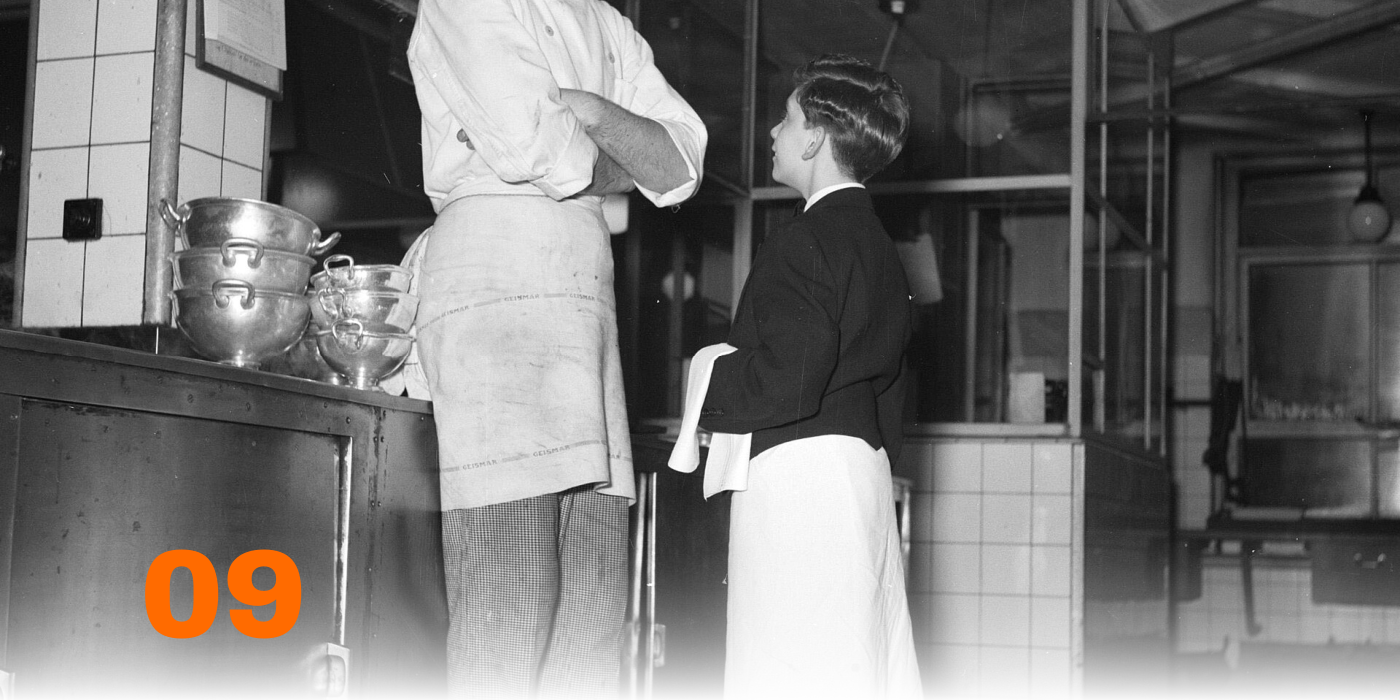
In a photograph taken in a hotel kitchen, nothing is happening. A cook in whites stands with his arms folded. In front of him, half his height, is a boy in a black jacket and a long white apron, the youngest of the brigade, looking up at him. Neither of them is cooking. The cook is saying something and the boy is listening, and that is the only reason why, ten years from now, there will still be someone able to run that kitchen.
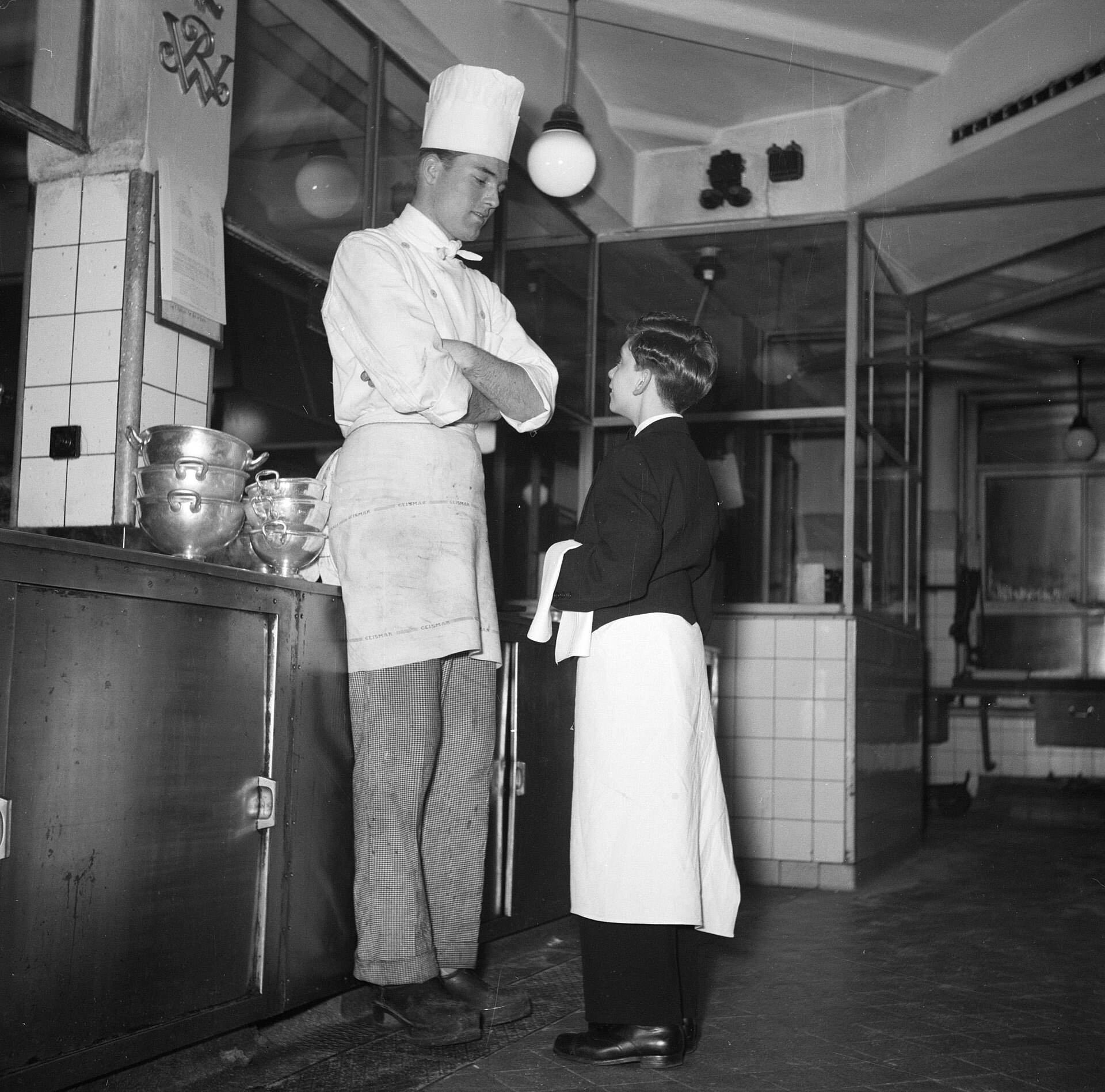
I have had that scene in mind ever since I started reading what gets written about artificial intelligence and the young. Because the whole discussion takes for granted something that is not granted at all: that such a moment still exists inside a company.
We need a distinction nobody ever makes, and without it there is no way out of this.
A job is what you do today. A task, a shift, an output somebody measures. It is assigned, it is counted, it is paid by the hour. A trade is what stays with you once that task is gone: knowing where to look, sensing that something is about to go wrong before it does, recognising the customer who comes in on Thursdays. A job is given to you. A trade you take, and you can only take it from somebody who has one.
Artificial intelligence is very good at doing the job. It has not touched the trade at all, because there is nothing there to touch: a trade does not travel through a file, it travels from one person to another, face to face.
The problem is a different one, and it is entirely ours. We used to pass the trade on by stealth, hung on the boring work.
Think about what a twenty-three-year-old is given to do in their first weeks. Reordering numbers, rewriting a document somebody else has already written, checking that one list matches another. These are tasks of little use to the company, and whoever assigns them knows it perfectly well. They are not assigned because they are needed: they are assigned because while you do them you are in the building, and by watching you learn how the house you have entered is put together.
It is the lowest rung on the ladder, and it is exactly the rung a machine does better than a boy in his first week. Faster, at any hour, without getting the formatting wrong. Anyone who runs a company worked this out on their own, without needing to read anything: the first place where artificial intelligence genuinely pays is precisely there, on the work you used to hand to the person who still had everything to learn.
Now the machine does that work, and the trade that used to ride on top of it is no longer included in the price.
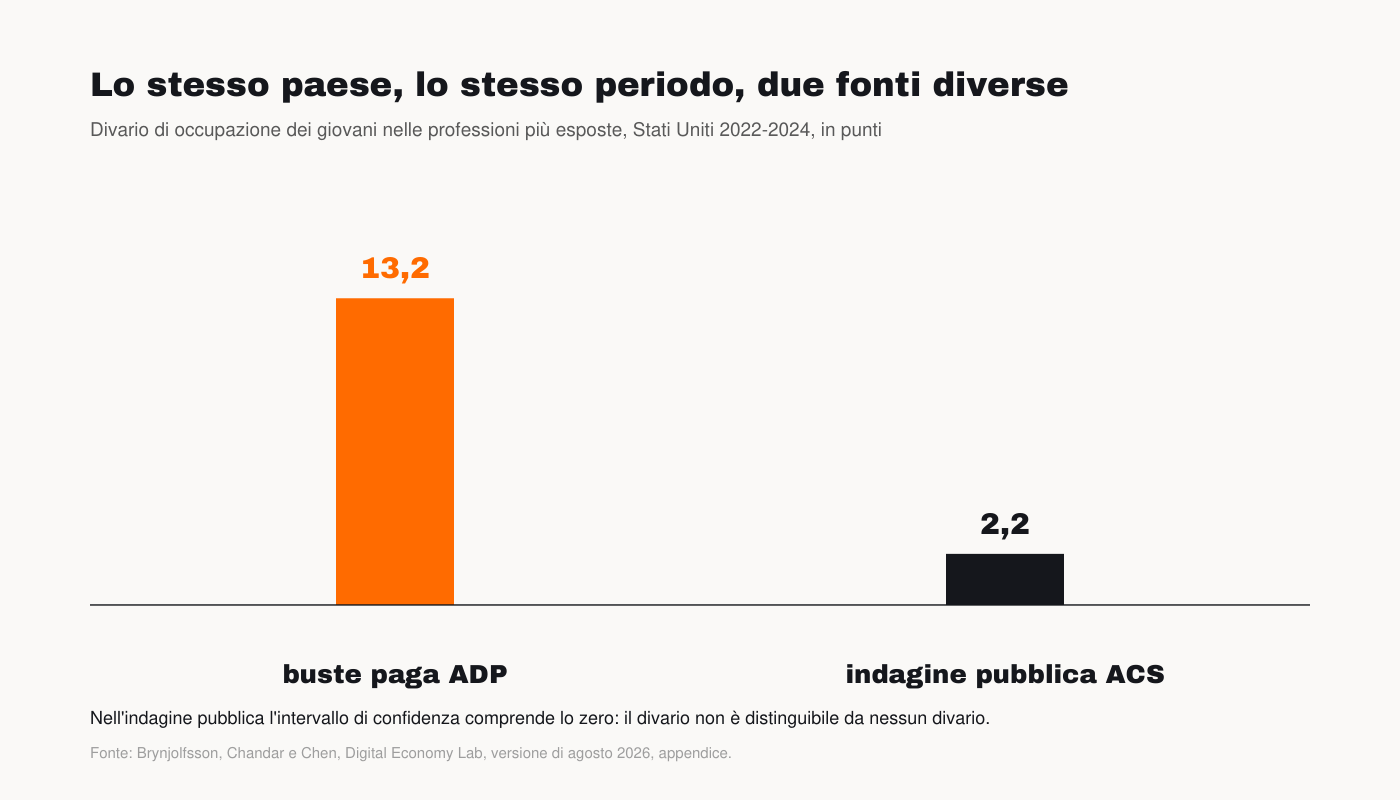
The answer doing the rounds is a single number, and it comes from a Stanford study: in the United States, employment among twenty-two to twenty-five-year-olds in the occupations most exposed to artificial intelligence is said to sit nineteen per cent below where it would be had it kept pace with their less exposed peers.
The number is true, but it does not mean what people make it mean. Almost everyone reports it as a nineteen per cent fall, and it is not: it is the gap from an imaginary trajectory. The people actually employed in that age bracket, within the sample, drop by less than two per cent. Between those two sentences lies the difference between a collapse and a slowdown.
And there is more, which the authors say first. It is not a peer-reviewed study, it is a working paper. The data come from the company that processes American payrolls, the same one that funds the lab and reads the text before it goes out. The number in the title grew three times in a single year while the statistic being measured changed, and if you account for how many graduates there are in the firms observed, the effect halves and in one version stops being significant altogether. They write this themselves, in the appendix. The headline got bigger while the evidence got weaker.
Then somebody went and redid the count outside the United States, and did not find it. In Finland the exposed occupations and the sheltered ones move together. In Denmark a Chicago Booth study finds no effects worth mentioning, and finds something far more interesting instead: the fall in entry-level roles is there and looks like the American one, but it is not driven by the firms that adopted chatbots. Something is happening, but it is not what we think.
A perfect example arrived while I was writing, and it is five days old. Uber announces three thousand three hundred job cuts and the Italian headlines lead with robotaxis: fewer people, more self-driving cars. Then you open the memo the chief executive sent to staff, which is a public document, and there is not a line about artificial intelligence. There is the fact that revenue has almost tripled in five years and that growth brought “more layers, more coordination, more diffused ownership”.
The detail that matters is the shape of the cut. What goes is mostly managers, at twice the average rate. If automation were eating entry-level jobs, that cut would have exactly the opposite shape: it would not be the middle of the org chart leaving, it would be the bottom.
I am not saying the phenomenon does not exist. I am saying that number is not the proof that it does, and that anyone using it as proof is borrowing a confidence its own authors do not have.
In the Italian press that nineteen per cent has been recycled as though it were about us. There is even a local version of it, credited to an observatory that is not a public institute but the platform of a private venture builder.
The real Italian data go the other way, and not by a little. INPS, which sees every contract because it registers them, counts eight hundred and fifty thousand more employees aged eighteen to thirty-four between 2019 and 2025, while that age group was emptying out. And when the Ministry of Labour crossed exposure to the machines with actual hiring for the first time, it found that in the most exposed occupations hiring is growing, and that permanent contracts there run at more than double the average. The entry contract is more common exactly where the machines are arriving fastest.
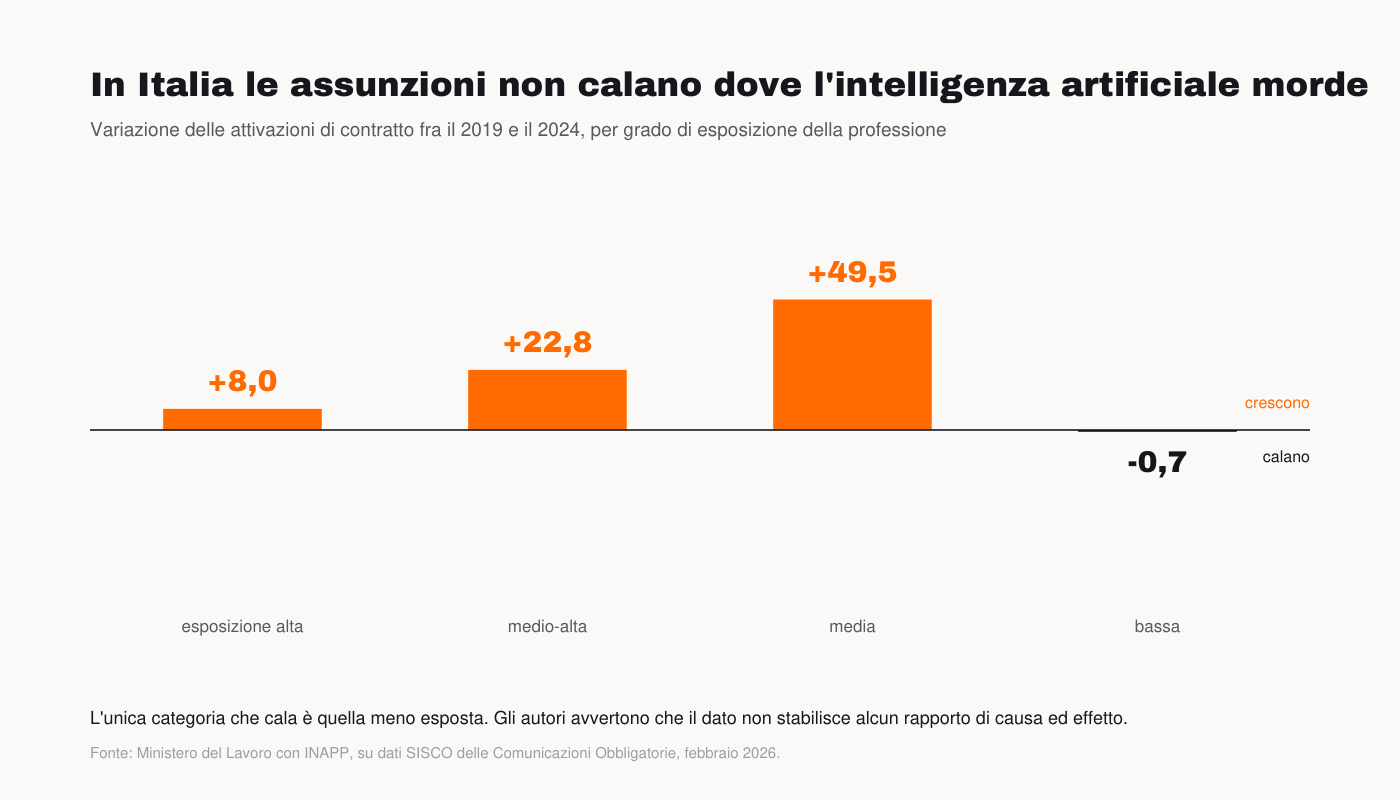
There is a mundane reason for this, and it is worth saying: here artificial intelligence is still barely used. The effect is invisible partly because there is not yet enough cause.
And here comes the part that actually interests me, because it is the only one a business owner can do something about.
The right question is not whether artificial intelligence is destroying entry-level jobs. The question is whether, here, those jobs ever taught a trade at all, before the machines turned up.
There is a way of answering that leaves no room for argument, and it is to follow real people for long enough. INAPP did it: two hundred and thirteen thousand young people hired as apprentices, tracked for ten years. Ten years on, three in four are still working and almost half hold a permanent contract with somebody. With the company that trained them, eight in a hundred stayed.
Ninety-two out of a hundred leave the place where they learned.
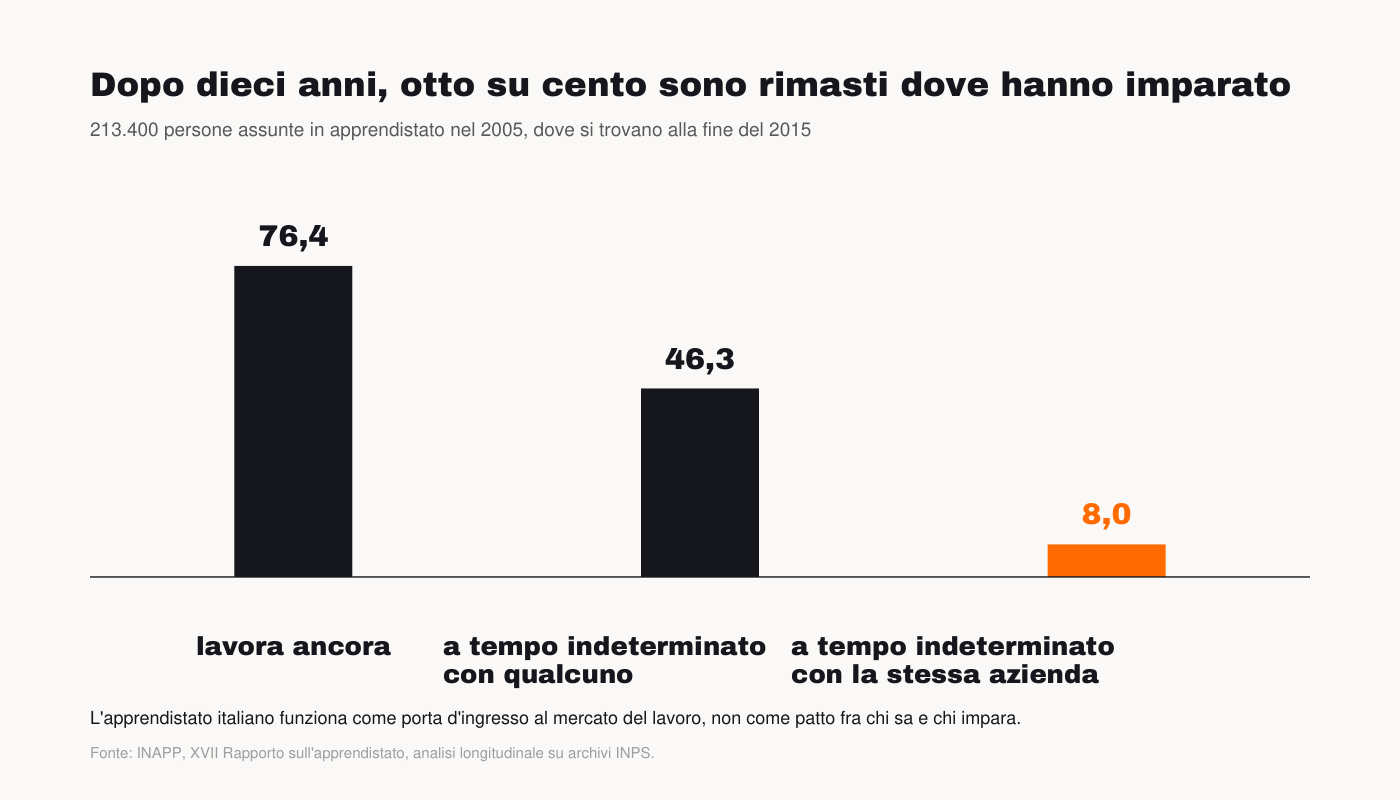
And there is a detail that says it even better. When the conversion to a permanent contract comes, it almost always comes from the third year onwards, hardly ever within the first. Which means it arrives when the payroll tax breaks expire, not when the young person has learned the trade. This is not a pact between one who knows and one who is learning: it is a revolving door with a tax incentive hanging over it.
The rest of the ladder is no better, and one comparison is enough. Genuine dual apprenticeship, the kind that puts school and workshop together, covers fewer than twelve thousand people in Italy. In Germany it covers more than one million three hundred thousand.
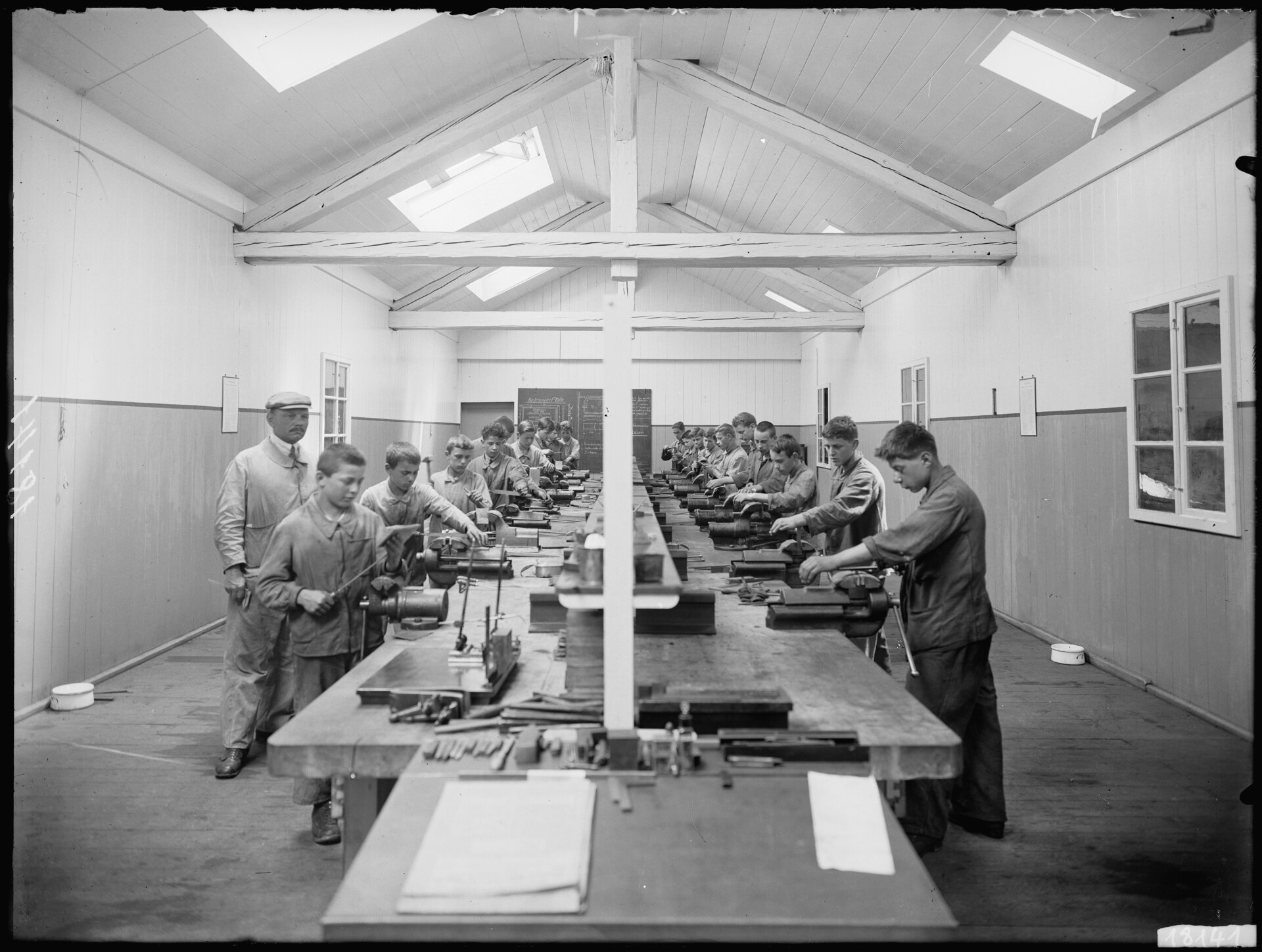
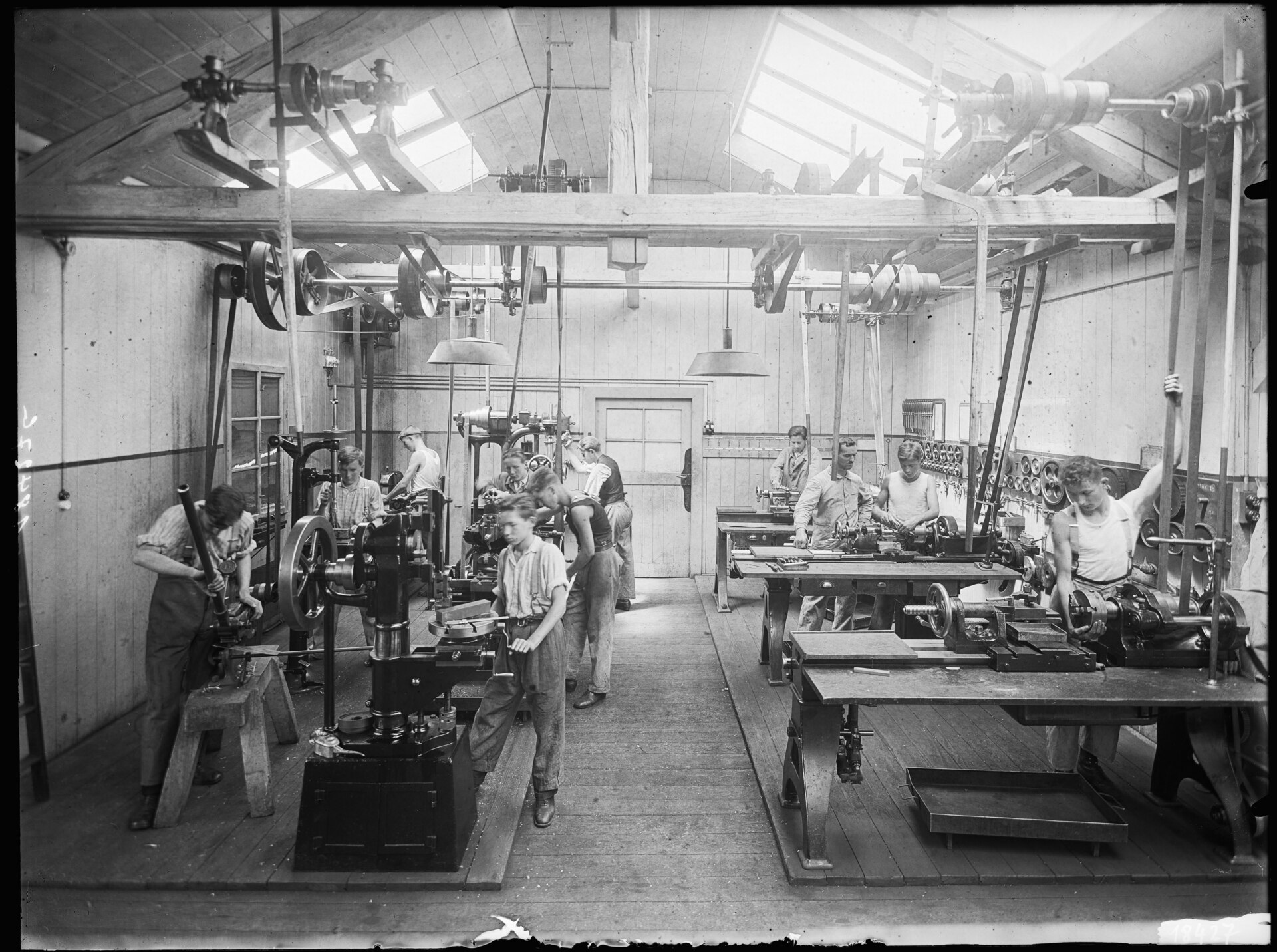
Look at another photograph. A workshop, boys at the lathes, and on the left a man in a cap doing nothing. He is not holding a part, not turning a handle, not producing anything that can be sold. He is watching. That man costs money: he is an hour of a skilled worker, spent not producing. He is the first line item cut when a company is in a hurry, and we cut him long before ChatGPT existed.
For a while we told ourselves a decent story about it, because as long as the first rung was made of useless tasks you could argue that at least they got you in the door. Now a machine does those tasks, and what is left exposed is the thing the first rung was supposed to do and was not doing.
I have to say something that cuts against half of what I have written so far, and I say it because I see it every day.
I have trained a lot of young people in the kitchen and in the dining room. Hospitality is still a very traditional business, and it has something offices have lost: your hands are in it from day one. There is no fake task to hand the new arrival to keep them busy while they watch. There is service, and service has to be done. You learn by working and by making mistakes inside service, which is also the only place you can genuinely make one, because the error shows immediately and you are the one who sees it.
Being manual work, it is bound to be that way. And there is a consequence that weighs more than it seems: anyone who catches the passion sees the improvement day after day. They know whether they are getting good, and they know it by themselves, without anyone certifying it. It is far less demoralising than a first year spent reordering numbers somebody else will check again.
That is why the trade still passes on in my line of work: because the job and the trade are the same thing. The task I give you on day one is not fake, it is service, and while you do it you take the trade yourself, because the result is in front of you within a minute.
So the dividing line is not the one everybody describes. It does not run between occupations exposed to artificial intelligence and occupations sheltered from it. It runs between jobs that contain a trade and jobs that contain none.
Where the job contains the trade, the machine has nothing to take: it cannot plate a dish for you, it cannot take the dining room on a Friday night, it cannot solder a pipe under a sink. Where the job was only ever a job, the first rung was not teaching anything before either. It kept people busy. And that, yes, the machine takes, and it is right to take it.
There is a serious piece of evidence pointing the opposite way to this whole article, and skipping it would be dishonest.
The same economist who signed the nineteen per cent study signed another one, this time published in a proper journal, on thousands of customer support agents given a generative assistant. Productivity rises for everybody, but it rises above all for the new ones: on the experienced hands the effect is close to nil. And there is the figure that matters most of all: a beginner with two months of tenure plus the machine works as well as, or better than, someone with six months without it. When the assistant broke down, those who had been using it went on working better than they had before.
Two months with the machine are worth six without. If that holds, artificial intelligence is not removing the first rung: it is shortening it. The authors add the right caveat, though, and it is worth keeping: they cannot tell whether those workers are learning a trade or merely following a suggestion. That is exactly the distinction we are talking about, and today nobody knows which side it falls on.
Even granting that the American number is an artefact, and even granting that the machines teach rather than subtract, there is still a reason not to leave this to chance.
Three economists followed fifteen cohorts of Canadian graduates. Those who graduate in a bad year start on lower pay and catch up over ten years. But that is the average, and the average hides everything here: those starting from the top bracket recover almost all of it within four years, those starting from the bottom are still behind after ten, and they stay there.
Entering badly does not cost you a year. It costs you a decade. And not everybody pays the same price: the weakest pay it, which is precisely why anyone who cares about freedom should look at this closely. The freedom to choose what work to do is worth very little if your first job is assigned by the accident of the year you were born.
I have no grand thesis to sell. I have one small thing that works and that convinced me.
In an experiment run inside an American call centre, one group of workers was given structured time to talk to a colleague. Not a course, not formal mentoring: time, with a slot and a shape. Revenue per call went up considerably, and what matters more is that it stayed up after the experiment ended. Another group was given money tied to the pair’s joint result instead: during the experiment it rises, the moment it ends it collapses back to where it started.
Time to talk works. Paying people to pass things on does not.
That is the angle from which I look at artificial intelligence in my own companies, and the conclusion is less futuristic than it sounds. I give the machine the work that taught nobody anything, and I give it gladly, because taking that away from a person is no loss. But what that work used to carry with it by accident, namely the time a young person spent inside the company watching how it runs, that has to be put back deliberately, with a slot and a shape, because it no longer arrives for free.
Putting the man in the cap back costs money. In a kitchen you do not need him, because there the young cook works out for himself whether the dish was right. In front of a spreadsheet nobody works it out, unless somebody tells them.
The machine takes the job, and it can take all of it. Nobody can take the trade, because it is written down nowhere: it passes from one person to another person, and so far nobody has automated that.
But a thing nobody can steal from you, you can still throw away yourself. If we simply remove the work and put nothing back, in ten years we will have a generation that worked a great deal and never learned a trade. And it will not be the machines’ fault.