
On 22 March Milan voted on the justice reform and said no, with 58.3 per cent. Across Italy the no stopped at 54. In Lombardy the yes won, with 53.6.
The largest city in the region voted against its own region, and it was not alone: Bergamo, Brescia, Como, Pavia, Monza, Mantua and Lodi said no too. Every provincial capital on one side, the rest of Lombardy on the other.
619,790 people voted out of 951,417, a turnout of 65.1 per cent. At the 2021 city elections, 47.7 per cent turned out. A third more Milanese left the house for the justice reform than to choose their mayor.
District 1 is the only one of the nine where the yes beat the no: 51.1 against 48.9. In a city that rejects the reform with 58.3, the historic centre votes against everywhere else, and it is also the district where most people voted, close to seventy per cent. At the far end sits District 3, with 61.1 per cent no. Twelve points between two parts of the same city, on a question that has nothing to do with geography.
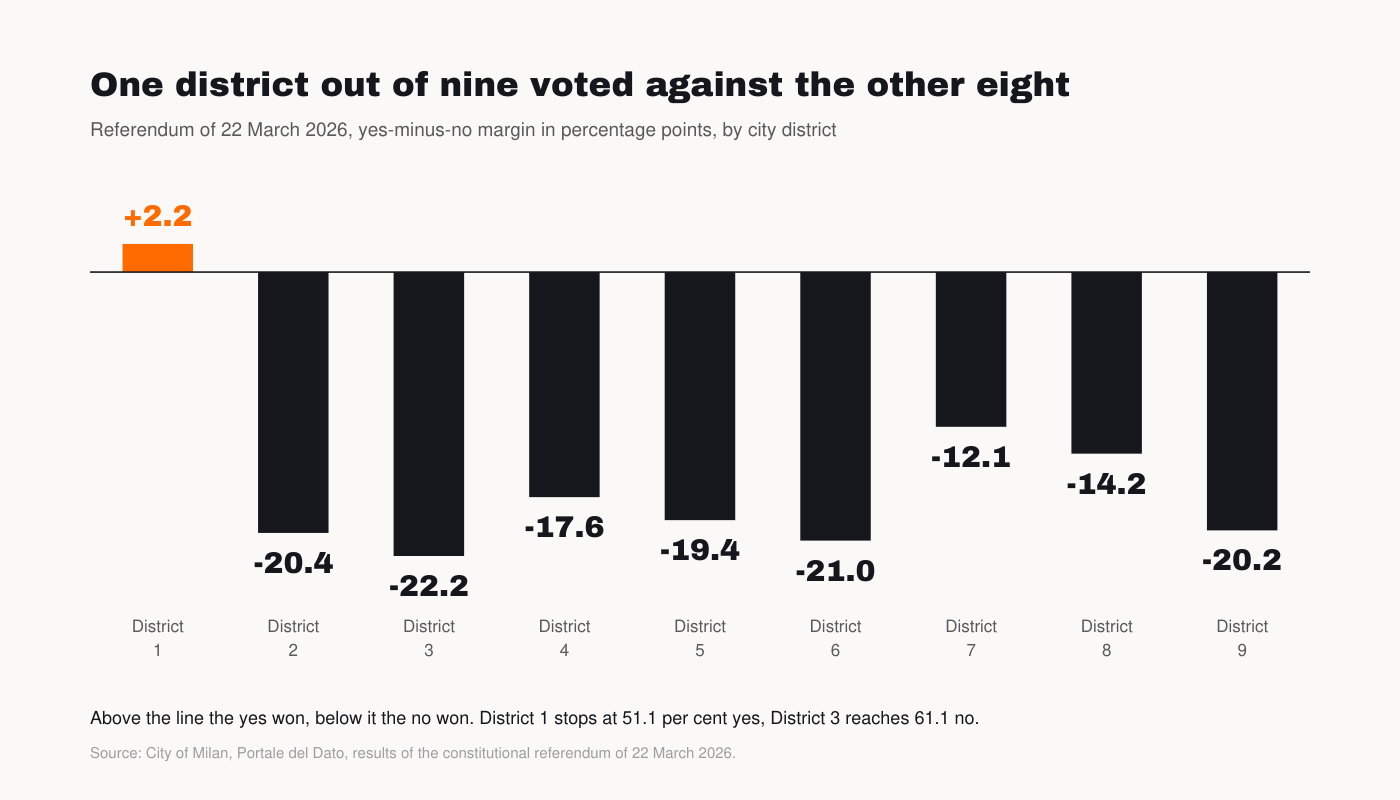
Source: City of Milan, Portale del Dato, results of the constitutional referendum of 22 March 2026.
It had already happened nine months earlier
Nine months earlier, on 8 and 9 June 2025, Italians voted on citizenship and on labour law. The quorum was not reached: national turnout was 30.6 per cent. In the seven largest cities it reached 36.9, six points above the average, and those cities hold 13 per cent of the electorate but 16 per cent of national income, 31,000 euros a head against 24,300.
Inside Milan the split was identical. Around the Duomo the yes on citizenship ran nine points ahead of the yes on labour. In Muggiano, Roserio and Triulzo Superiore the opposite happened, thirty points apart.
Sources: City of Milan for 2026; YouTrend, 11 June 2025, for the neighbourhood analysis.
Two referendums nine months apart, on subjects with nothing in common, and the city splits along the same line both times. When the fault line does not move as the question changes, it is not answering the question.
What happened to the people who live here
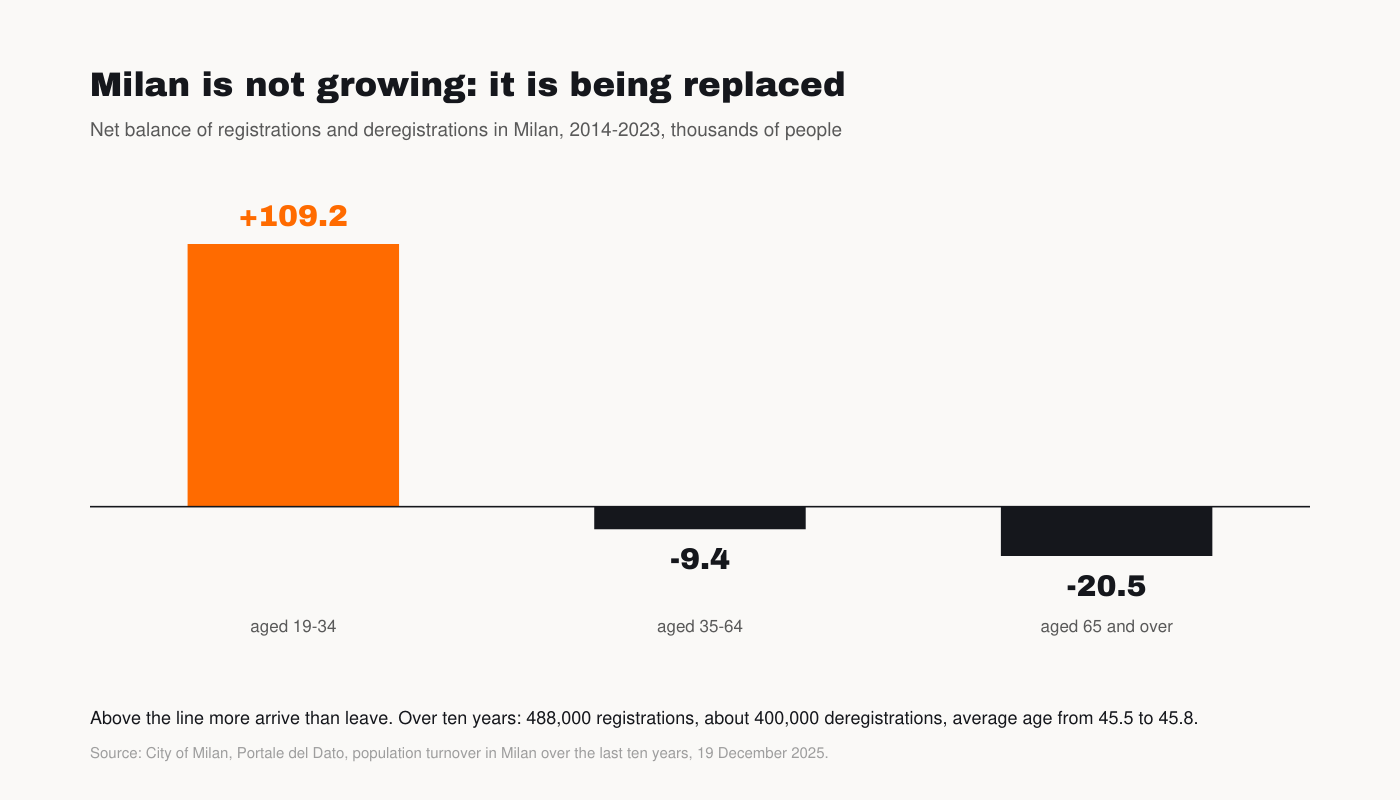
Between 2014 and 2023 the city recorded 488,000 registrations at the register office and about 400,000 deregistrations. A third of the residents of ten years earlier were replaced, while the population grew by 4 per cent. In ten years Milan grew a little and turned over a lot.
The age breakdown says the rest. Among people aged 19 to 34, 241,567 arrived and 132,364 left: a hundred and nine thousand more. Among those aged 35 to 64 the balance is minus nine thousand four hundred. Above 65, twenty thousand five hundred people are missing.
The average age barely moved, from 45.5 to 45.8 years. The people change, the profile does not.
Source: City of Milan, Portale del Dato, update of 19 December 2025.
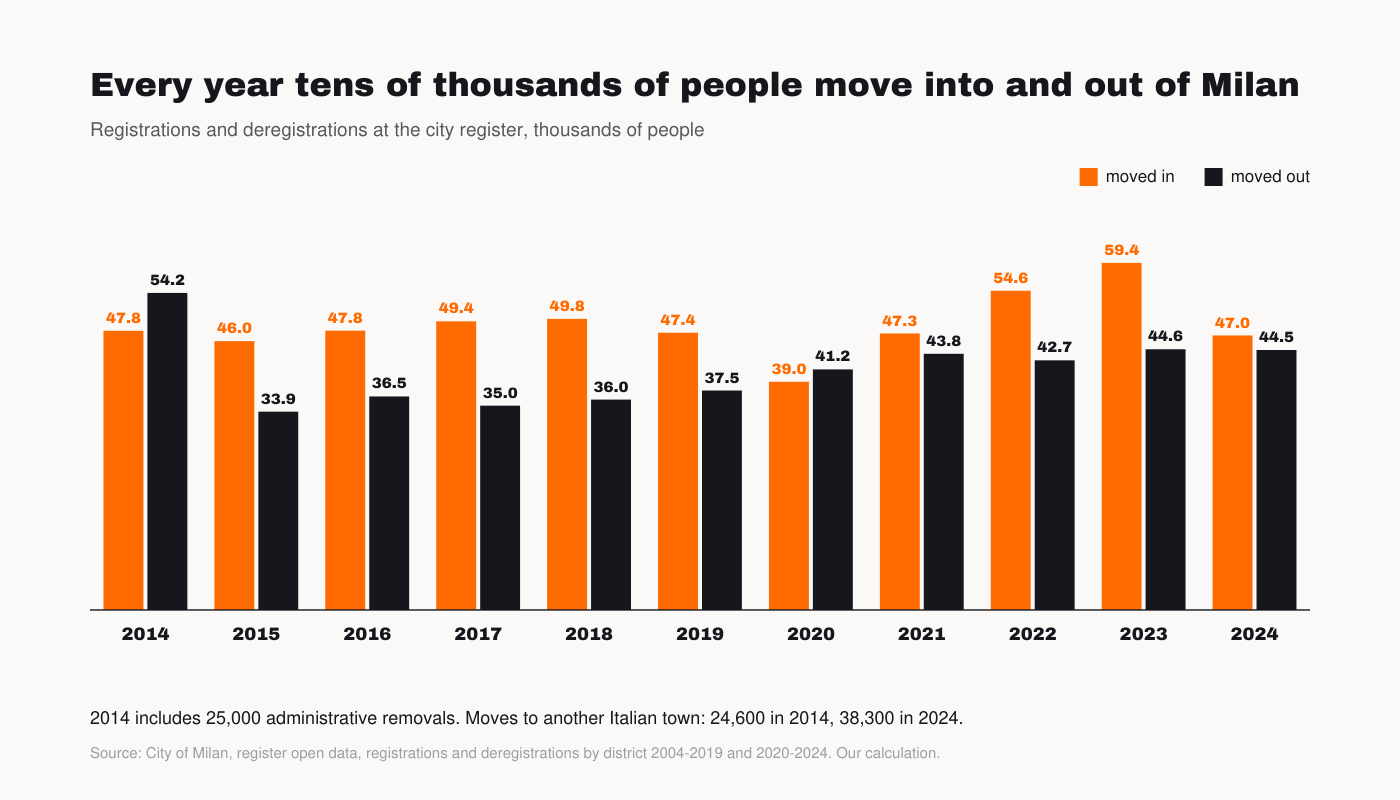
And there is one last figure, which explains where the others went: of those who leave Milan, 31 per cent stay in the towns of the surrounding belt. And there are more of them every year: moves from Milan to another Italian town went from 24,600 in 2014 to 38,300 in 2024, up by more than half. They stay within reach of the city: what pushed them out was the price.
Source for the 2014-2024 series: City of Milan, register open data, our calculation.
The explanation going around, and why it is not enough
The reading in circulation is the comfortable one: Milan changed its mind because it changed its inhabitants. It deserves to be taken seriously, because the first half is true and we have just counted it. The trouble is the second half.
If turnover on its own produced a political leaning, ten years of replacement like that should have delivered a uniform city. It delivered two. District 1 and District 3 received the same flow over the same decade, with the same proportions of Italians from other regions and of foreign nationals, and in March they voted in opposite directions. Newcomers pick up their vote where they end up living.
And where they end up living is decided by the price, which in Milan is the most selective thing there is.
You become Milanese, but only on one side of the line
What follows is my own opinion, because there is no statistic on assimilation.
Milan does two things, one after the other. First it selects, then it shapes. It selects because to move here at twenty-seven you must already have accepted a bargain, and the bargain is written into the rents: you work a lot, you pay a lot, you live in very little space, and in exchange you get a city that opens doors for you. Whoever does not accept the bargain never arrives, or arrives and goes home after two years. Then it shapes, and here the much-discussed conformity really does exist: after three years you complain about the tourists in the Duomo, you arrange to meet people by naming a metro stop, and you vote like your neighbours on the stairs. You become Milanese, and fast.
Except you become Milanese of one part of Milan. The mechanism runs inside the ring road and stops where the rents begin that one person can pay on their own. In those neighbourhoods just as many new people arrive as in the centre, but the neighbour you take your bearings from is a different one, and the city opening doors for you is not the same city. Then a referendum comes along, any referendum, and the difference shows up in figures.
The political point
Now the part that concerns me, because in this city I do not only run businesses.
Security in Milan is a real problem and people feel it, and anyone who says otherwise does not take the metro in the evening. But it is not the issue that will win the election. It will do something else: it will settle the balance of power inside the centre-right, and the relationship with Vannacci’s lists. It is a battle that moves votes within the coalition.
Milan meanwhile keeps drifting left. Demography plays a part, and so does the fact that nobody has offered it an alternative city. I say this from the inside, because it is my own side: the Milanese political class on my side of the argument is not equal to the city it wants to govern. And not by a little.
You only need to look at what gets proposed. Against the cycle lanes, against the low-emission zone, against the bus lanes, against the decay. Lined up together, they say that Milan is no good today, and nothing about how it should work ten years from now.
Milan is not the city of No. It is the city where, if you tell it no, it needs to hear what you would do instead. A no without an alternative collects nothing here. And in a city where a third of residents arrived in the last ten years, and came here on purpose, promising to undo the things they came for sounds like a threat.
These are individual battles fought for personal standing rather than a shared plan for the city. The difference is in the timing and in who collects. A plan bears fruit after five years and it bears it for everyone; an identity battle gives you visibility tonight, and gives it to one person. Anyone who needs to make a name picks the second, and that is a rational choice. The trouble is that twenty rational choices like that add up to a list of people getting themselves noticed.
That is why security gets picked and housing does not. Security works beautifully as an individual battle: you take it to the council on your own, you explain it in three lines, you go on television. A housing policy forces you to agree with other people for years, and the credit, if it ever comes, comes to everyone at once.
Milan runs ahead, but only when somebody brings it something
People say Milan runs ahead of the country. On votes it does not hold up: in December 2016 the city said yes to the constitutional reform with 51.1 per cent, while Italy said no with 59.1. If it were a seismograph of the national vote, it would have broken that night.
What Milan runs ahead on is political offers. On 20 June 1993 it elected Marco Formentini with 57.1 per cent: the first League mayor of a major Italian city, nine months before that coalition won the general election. On 30 May 2011 it elected Giuliano Pisapia with 55.1, five and a half months before the government of the day fell. Both times Milan picked a new offer first, and the country got there afterwards.
Which means the reverse is also true. When nobody brings it a new offer, Milan runs ahead of nothing. It stays where it is. That is what is happening now, and the responsibility lies with those who bring it nothing.
What those numbers actually say
The fault line is not between those born here and those who arrived. If it were, the centre, which has more new people than anywhere else, would be the part of the city least like itself, and instead it is the only part holding a steady position for ten years. The fault line is between those who can pay for the centre and those who cannot, and that is something you can govern.
Of those who leave Milan, 31 per cent stop in the towns of the belt. Every decision that makes the centre more desirable without increasing how much gets built pushes that boundary a kilometre further out, and a slice of the electorate moves with it. Then people read a referendum result, discover that the city splits along the same line every time, and act surprised.
The replacement is the result of decisions about housing, permits, transport and response times, and somebody took those decisions. The first person in Milan who manages to say what they want to build, instead of what they want to stop, will discover that this city was only waiting for someone to ask properly.